In 1982, Sweden’s parliamentary elections recorded near-identical turnout rates among native-born citizens and those born abroad. Four decades later, that parity has fractured. In the 2022 national election, nearly 90 percent of native-born Swedes cast a ballot, compared with approximately 65 percent among foreign-born residents. This widening civic gap is no longer a marginal sociological footnote. It is a structural indicator of how integration, institutional trust, and political participation intersect with economic policy, labour market dynamics, and long-term investment stability in one of Europe’s most export-oriented economies.
For senior executives, institutional investors, and policymakers, the trajectory of Sweden’s voting behaviour matters because it shapes the predictability of fiscal policy, the design of labour regulation, and the social capital upon which the Nordic business model relies. High-trust societies attract capital not merely through tax regimes or innovation clusters, but through broad-based civic alignment that reduces policy volatility and sustains public investment in education, infrastructure, and human capital. As Sweden’s demographic composition continues to shift, understanding the drivers and implications of this civic divide is essential for strategic planning and risk management.
The Widening Civic Divide: Data and Structural Drivers
Statistics Sweden (SCB) and independent academic research consistently show that foreign-born residents vote 8 to 15 percentage points less than their native-born counterparts in national elections. The disparity intensifies in local elections, where non-citizens gain voting rights after three years of residency: turnout among this group hovers between 34 and 39 percent, compared with 85 to 87 percent among Swedish citizens.
Several structural factors explain this pattern. First, administrative friction and limited familiarity with Sweden’s proportional, multi-party system can deter participation, particularly among newer arrivals. Second, citizenship acquisition remains a deliberate process in Sweden, and the legal distinction between residency and full political rights naturally suppresses turnout among long-term non-citizens. Third, socioeconomic positioning plays a measurable role: labour-market integration, housing stability, and access to civic information correlate strongly with electoral participation.
Notably, the gap is not static. Academic studies indexed through Sweden’s DiVA Portal demonstrate that second-generation immigrants, born and educated in Sweden, vote at rates closely aligned with the native population. Length of residence also matters: the likelihood of voting increases steadily over time. Furthermore, research from the Delegation for Migration Studies (Delmi) indicates that refugees participate at higher rates than labour or family-reunification migrants, suggesting that the nature of migration pathways, rather than origin alone, shapes civic engagement.
Internationally, Sweden’s experience mirrors broader European patterns. Norway has moved toward streamlined naturalisation to accelerate civic inclusion, while Germany’s recent citizenship reforms explicitly tie political participation to economic integration. In contrast, Denmark’s stricter residency and language requirements have been associated with lower municipal turnout among non-citizens. Sweden’s trajectory will likely hinge on whether policy levers are calibrated to reduce administrative barriers while fostering economic mobility.
Political Preferences and the Policy Trajectory
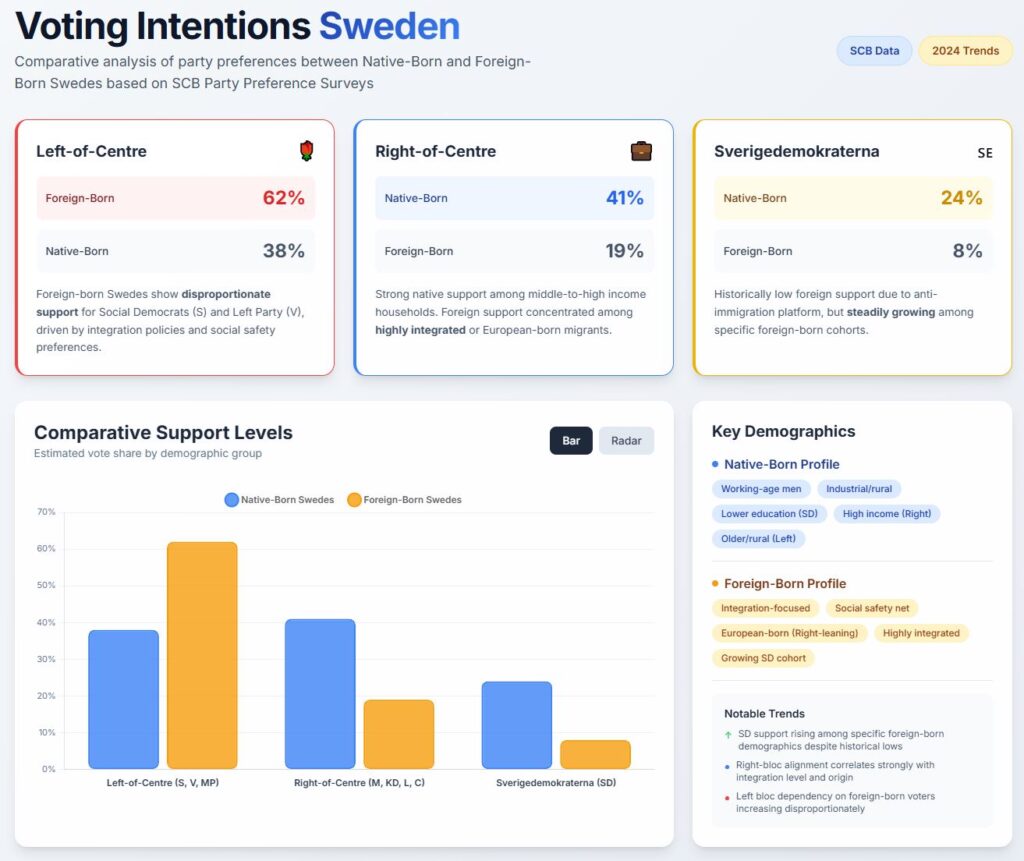
Voting behaviour in Sweden is not merely a reflection of turnout; it signals divergent expectations of the state’s economic role. SCB’s party preference surveys reveal clear ideological segmentation. Native-born voters form the stable base of centre-right parties, particularly among middle- to high-income households in urban and suburban regions. Foreign-born voters, by contrast, show disproportionate support for left-of-centre parties, notably the Social Democrats and the Left Party, driven by priorities around social safety nets, labour-market integration, and housing policy.
The landscape, however, is shifting. Support for the Sweden Democrats (SD), historically anchored among working-age, lower-educated native men in industrial and rural constituencies, has gradually expanded into specific foreign-born cohorts. Sociological tracking indicates that concerns around public security, neighbourhood cohesion, and economic precarity are aligning parts of the immigrant electorate with law-and-order and welfare-conditionality platforms. This convergence does not imply ideological uniformity; rather, it reflects how material conditions and lived experiences increasingly intersect with broader national policy debates.
For business leaders and investors, these preference shifts carry direct policy implications. A fragmented electorate complicates consensus-building on taxation, public spending, and regulatory reform. When voting blocs prioritise different economic models, governments face heightened pressure to balance expansionary social programmes with fiscal discipline, or to recalibrate labour market flexibility alongside integration mandates. The result can be incremental policy volatility, which affects long-term capital allocation, sectoral planning, and the predictability of regulatory environments.
Business, Investment, and the Social Contract
Civic participation is a leading indicator of social cohesion, and social cohesion is a pricing factor in modern investment analysis. Institutional investors increasingly incorporate social risk metrics into portfolio strategy, recognising that fragmented electorates correlate with higher policy uncertainty, labour market inefficiencies, and elevated compliance costs. In Sweden’s context, the voting gap intersects with three core business imperatives:
Labour market alignment. Sweden faces structural skills shortages in technology, healthcare, engineering, and advanced manufacturing. When foreign-born residents remain economically marginalised or politically disengaged, the economy forfeits human capital, while firms absorb higher recruitment and training costs. Inclusive hiring, credential recognition, and targeted upskilling are no longer solely corporate social responsibility initiatives; they are operational necessities.
Regulatory predictability. Divergent voting patterns often translate into competing policy demands on housing, taxation, and welfare conditionality. For multinationals and domestic firms alike, navigating shifting regulatory frameworks requires scenario planning and adaptive governance structures. Companies that engage constructively with municipal integration programmes, public-private training initiatives, and transparent stakeholder dialogue can mitigate policy risk and strengthen licence-to-operate.
ESG and social capital reporting. Under the EU’s Corporate Sustainability Reporting Directive (CSRD) and growing stewardship expectations, firms must disclose how they contribute to social inclusion, workforce development, and community stability. Civic integration metrics, supplier diversity, and local employment initiatives are transitioning from peripheral reporting items to core governance criteria. Firms that treat civic inclusion as a strategic asset, rather than a compliance exercise, will likely see improved risk-adjusted returns and stronger institutional investor alignment.
Convergence, Civic Innovation, and the Road Ahead
The long-term trend remains favourable: second-generation convergence, extended residency, and targeted policy interventions consistently narrow the voting gap. Yet the pace of convergence depends on institutional design and private-sector participation. Several pathways warrant attention:
Streamlining civic onboarding. Digital public services, multilingual voting information, and simplified naturalisation processes can reduce friction for eligible residents. Nordic peers have demonstrated that targeted civic tech investments yield measurable turnout improvements without compromising electoral integrity.
Aligning education and labour market policy. Recognising foreign qualifications, expanding apprenticeship pathways, and incentivising employer-led integration programmes can accelerate economic mobility, which in turn drives political participation.
Public-private civic partnerships. Municipalities, business associations, and civil society organisations can co-fund mentorship, financial literacy, and civic education initiatives. Such programmes strengthen social trust while expanding the talent pool for scaling industries.
Sweden’s demographic reality makes civic inclusion an economic imperative. An aging native population, coupled with sustained demand for skilled labour, means that political and economic integration are mutually reinforcing. Policymakers who treat voting participation as a barometer of systemic health, and business leaders who view civic engagement as a component of long-term value creation, will be better positioned to navigate the next decade of European economic realignment.
Strategic Perspective
The widening voting gap in Sweden is not merely a political statistic; it is a structural signal of how integration, institutional trust, and economic policy intersect. For executives and investors, the lesson is clear: social cohesion is a foundational element of market stability. Companies that proactively support labour-market inclusion, transparent stakeholder engagement, and civic education will reduce regulatory friction and strengthen long-term competitiveness. Policymakers who streamline administrative pathways, align integration with skills development, and foster cross-sector partnerships will sustain the high-trust environment that has historically underpinned Nordic economic resilience. The ballot box is not isolated from the balance sheet. In an era of demographic transition and geopolitical recalibration, civic participation and economic strategy are increasingly inseparable.
Editorial Outlook
Follow-up Proposal: “The Economic ROI of Civic Inclusion: How Nordic Firms Are Turning Integration into Competitive Advantage.” A data-driven examination of corporate-led integration programmes, public-private skills partnerships, and their measurable impact on labour productivity, retention, and regional investment flows across Sweden, Norway, and Denmark.
Nordic Business Journal
We welcome dialogue with executives, investors, and policymakers shaping the next phase of Nordic economic strategy. For insights, partnership opportunities, or commissioned research on social cohesion, labour-market innovation, and investment risk, please connect with our editorial and advisory teams at insights@nordicbusinessjournal.com or through our executive briefing network.