As Stockholm weighs higher fuel prices to meet its 2045 climate goals, the political and economic implications extend far beyond the petrol pump.
Sweden’s climate transition has long been viewed as a model of pragmatic Nordic policymaking: ambitious environmental targets combined with market-based incentives, technological innovation, and industrial competitiveness. Yet a government-commissioned inquiry proposing significantly higher fuel prices has exposed a growing tension at the heart of Europe’s green transition — how to reconcile climate ambition with affordability, political legitimacy, and economic resilience.
The inquiry, led by investigator Svante Mandell, argues that Sweden may need to raise fuel prices by approximately SEK 3 per litre through higher fuel taxes and expanded biofuel blending requirements in order to remain aligned with national and EU climate commitments. The proposal arrives at a politically sensitive moment, following years of elevated energy prices, inflationary pressure across Europe, and growing voter fatigue around rising living costs.
While ministers in the current government have already distanced themselves from the prospect of higher pump prices, the broader debate is unlikely to disappear. Sweden’s transport sector remains central to the country’s legally binding target of achieving net-zero greenhouse gas emissions by 2045, and the policy choices made over the next several years will shape investment flows, industrial competitiveness, household economics, and the pace of electrification across the Nordic region.
The issue is therefore not simply about fuel taxation. It is about how advanced economies finance the transition to low-carbon systems while maintaining social cohesion and economic credibility.
A Climate Leader Facing Political Constraints
Sweden’s climate framework remains among the most ambitious in Europe. The country has committed to reaching net-zero emissions by 2045, five years ahead of the European Union’s broader 2050 target, with significant interim milestones for transport emissions and non-ETS sectors.
However, recent policy developments have complicated that trajectory. In response to inflation, energy market volatility, and public concern over household costs, Sweden has lowered fuel taxes and reduced the “reduction obligation” — the mandatory blending of biofuels into petrol and diesel. Those measures helped ease consumer pressure but also weakened incentives for rapid decarbonisation in transport.
The Mandell inquiry effectively argues that Sweden now risks missing both national and EU climate obligations unless policy becomes materially more interventionist.
The proposed framework combines several measures:
- Higher fuel taxes on petrol and diesel
- A gradual increase in biofuel blending requirements
- Reduced electricity taxation to support electrification
- Incentives designed to accelerate electric vehicle adoption and retention within Sweden
The logic is economically coherent. Higher fossil fuel costs increase pressure to shift toward electric mobility and lower-emission alternatives, while cheaper electricity improves the economics of electrification for households and businesses.
Politically, however, the equation is far more complex.
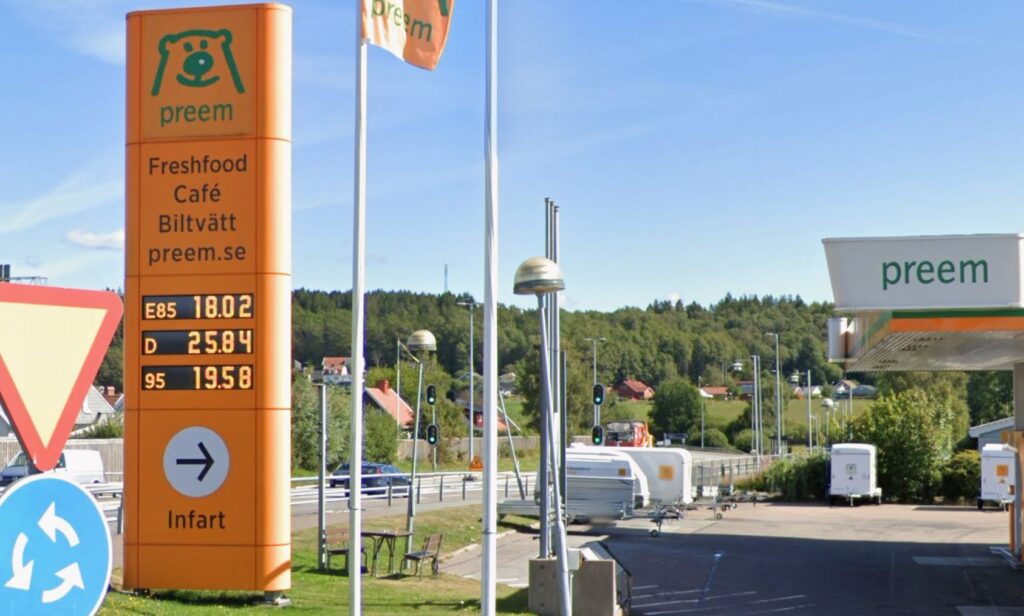
The Nordic Balancing Act: Climate Ambition Versus Cost-of-Living Pressure
Sweden is not alone in facing this dilemma. Across Europe, governments are confronting a more difficult phase of the green transition — one in which the easiest emissions reductions have largely been captured, while remaining cuts increasingly affect consumer behaviour, mobility patterns, industrial systems, and household budgets.
The Nordic region has historically enjoyed stronger public support for environmental taxation than many other markets, partly due to high institutional trust and relatively robust social safety nets. Yet even in Scandinavia, political tolerance for additional energy costs is showing signs of strain.
This tension reflects a broader shift in European climate politics. Earlier stages of the transition focused heavily on targets, commitments, and subsidy-driven expansion of renewable technologies. The current phase is increasingly about distributional economics: who pays, how quickly industries can adapt, and whether governments can maintain democratic support for decarbonisation policies.
The Swedish debate therefore mirrors wider European concerns:
- Can climate policy remain politically sustainable during periods of economic uncertainty?
- How should governments balance carbon pricing with industrial competitiveness?
- What mechanisms best protect rural households and lower-income consumers?
- How can Europe accelerate electrification without undermining mobility or productivity?
For policymakers and investors alike, these questions are becoming central to long-term economic planning.
Why Transport Remains the Critical Battleground
Transport remains one of the most difficult sectors to decarbonise. Heavy dependence on liquid fuels, long vehicle replacement cycles, infrastructure requirements, and behavioural inertia make rapid transition costly and politically sensitive.
Sweden’s challenge is particularly notable because the country has historically been considered a frontrunner in sustainable transport policy. Yet despite strong electric vehicle adoption rates and extensive renewable electricity generation, the country still faces a substantial emissions gap relative to its 2030 and 2045 objectives.
The inquiry’s emphasis on fuel pricing reflects a long-standing economic principle: price signals remain among the most effective tools for reducing fossil fuel consumption.
However, the effectiveness of carbon pricing increasingly depends on the availability of viable alternatives.
In urban regions, electrification is progressing rapidly. Charging infrastructure continues to expand, battery economics are improving, and corporate fleets are transitioning toward electric platforms. In rural Sweden — where long driving distances, colder climates, and infrastructure gaps remain more significant — the transition is slower and politically more contentious.
This geographic divide is becoming one of the defining structural risks in European climate policy.
If governments fail to manage regional disparities carefully, climate strategies risk generating political fragmentation between metropolitan economies benefiting from green investment and peripheral regions facing higher costs with fewer alternatives.
Electrification Is Becoming an Industrial Strategy
The Swedish inquiry also underscores a broader strategic reality: electrification is no longer solely an environmental objective. It is increasingly central to industrial policy, energy security, and economic competitiveness.
The Nordic region is positioning itself as a major hub for battery production, fossil-free industrial manufacturing, green steel, advanced energy systems, and clean technology innovation. Sweden in particular has sought to attract investment into electrified transport ecosystems and renewable industrial infrastructure.
Lower electricity taxation, as proposed in the inquiry, reflects recognition that electricity pricing may become as strategically important in the coming decade as fuel taxation was in the previous one.
The shift has several implications:
For industry
Energy-intensive sectors require predictable long-term electricity pricing to justify large-scale decarbonisation investments.
For automotive markets
Electric vehicle adoption increasingly depends not only on vehicle affordability, but also on charging economics, grid capacity, and residual asset values.
For investors
Infrastructure linked to electrification — including charging networks, grid modernisation, battery supply chains, and renewable generation — remains positioned for structural growth despite short-term policy volatility.
For governments
The transition requires balancing climate targets with industrial competitiveness, especially as Europe competes with the United States and China for clean technology leadership.
This is particularly relevant given the intensifying global competition triggered by US industrial subsidies under the Inflation Reduction Act and China’s continued dominance in battery manufacturing and critical mineral processing.
Biofuels: Necessary Bridge or Strategic Constraint?
The inquiry’s proposal to increase Sweden’s reduction obligation also reopens debate around the role of biofuels in Europe’s transition strategy.
Supporters argue that sustainable biofuels provide an important near-term mechanism for reducing transport emissions while electrification infrastructure scales. Critics, however, question long-term feedstock sustainability, cost efficiency, and the risk of locking economies into transitional technologies.
Sweden has historically been among Europe’s more active supporters of biofuel integration. Yet rising costs and supply-chain limitations have made the policy increasingly controversial.
For businesses, the issue is not purely environmental — it is operational and financial.
Logistics operators, freight-intensive industries, and transport-dependent sectors face increasing uncertainty around future fuel pricing structures, emissions regulation, and compliance costs. This uncertainty influences capital allocation decisions, fleet investment cycles, and long-term infrastructure planning.
Over time, the market may increasingly favour a diversified transition pathway:
- Electrification for passenger vehicles and urban transport
- Hydrogen and synthetic fuels for heavy industry and long-haul applications
- Biofuels as a transitional supplement in hard-to-electrify sectors
The pace and sequencing of that transition will vary significantly across European economies.
The Investment Signal Behind the Debate
Although public discussion has focused primarily on consumer fuel prices, the inquiry also sends a broader signal to markets: Sweden is likely to tighten climate policy over the medium term, even if implementation becomes politically gradual.
For investors, this matters.
Capital markets increasingly assess regulatory direction rather than short-term political rhetoric alone. The long-term trajectory across Europe remains oriented toward stricter emissions frameworks, expanded electrification, and higher carbon costs.
This creates both opportunities and risks.
Potential beneficiaries
- Renewable energy developers
- Grid infrastructure providers
- EV charging and mobility platforms
- Battery and energy storage companies
- Industrial decarbonisation technologies
- Energy efficiency and digital optimisation firms
Potentially exposed sectors
- Fossil-fuel-dependent logistics operators
- Internal combustion vehicle supply chains
- Carbon-intensive transport businesses
- Rural retail and distribution networks with limited electrification alternatives
The transition is therefore becoming less about environmental branding and more about operational adaptation.
Companies capable of reducing energy exposure, electrifying fleets, and integrating climate resilience into capital planning may gain structural advantages over the coming decade.
A Defining Test for European Climate Governance
Sweden’s fuel tax debate illustrates a broader challenge now confronting advanced economies: climate targets are easier to announce than to operationalise.
The next phase of Europe’s transition will depend less on declarations and more on implementation capacity — including infrastructure rollout, public acceptance, regulatory consistency, and industrial coordination.
That challenge is particularly acute in democracies where voters increasingly expect governments to deliver both decarbonisation and affordability simultaneously.
For Sweden, the outcome will carry symbolic weight.
The country has long been regarded as a global climate pioneer, supported by strong institutional credibility and relatively stable political consensus. If even Sweden struggles to sustain ambitious climate pricing policies during periods of economic pressure, other European governments may face even greater resistance.
At the same time, failure to accelerate emissions reductions could ultimately impose higher long-term economic costs through regulatory penalties, stranded assets, delayed industrial adaptation, and reduced competitiveness in emerging clean technology markets.
The debate is therefore not whether transition costs exist. It is how transparently governments manage them — and how effectively those costs are distributed across society.
Conclusion: The Real Price of Transition
The Swedish inquiry may not lead directly to a SEK 3 increase in fuel prices. Political realities, coalition dynamics, and economic conditions will likely reshape the final policy outcome.
Nevertheless, the report reflects a broader truth increasingly acknowledged across Europe: achieving climate targets will require more difficult economic decisions than earlier phases of the transition demanded.
For business leaders, the strategic message is becoming clearer.
The era of low-friction decarbonisation is ending. The next stage will involve deeper structural transformation across transport, energy systems, industrial production, taxation, infrastructure, and consumer behaviour.
The countries and companies that manage this transition most effectively will likely be those capable of balancing three competing priorities simultaneously:
- Climate credibility
- Economic competitiveness
- Social and political stability
Sweden’s current debate may therefore prove less significant for the precise cost of petrol in 2028 than for what it reveals about the future political economy of the European green transition.
Editorial Outlook
Suggested Follow-Up Feature:
“The New Nordic Energy Economy: How Electrification Is Reshaping Industrial Strategy Across Scandinavia”
A future editorial could examine how Sweden, Norway, Finland, and Denmark are repositioning themselves within the emerging European clean-industrial landscape. Potential angles include battery manufacturing, grid investment, hydrogen infrastructure, green steel production, critical mineral strategy, AI-driven energy optimisation, and the geopolitical implications of Nordic energy independence.
The article could also explore whether the Nordic region can maintain its global reputation for sustainable leadership while preserving industrial competitiveness amid intensifying pressure from the United States, China, and evolving EU industrial policy.
Engage With Nordic Business Journal
Nordic Business Journal welcomes dialogue with executives, investors, policymakers, founders, researchers, and industry leaders shaping the future of Nordic and global business.
For editorial inquiries, strategic partnerships, thought leadership opportunities, or discussion around the economic transformation of the Nordic region, connect with Nordic Business Journal to continue the conversation.