Executive summary
A year‑long review by Swedish Radio Ekot of Swedish ministers’ personal investments has prompted a wave of divestments and a tightening of ethical guidance within the Government Offices. Ministers from across the political spectrum — including Civil Affairs Minister Erik Slottner and Foreign Minister Maria Malmer Stenergard in her earlier ministerial role — have sold holdings in companies that intersected with government decisions. The episode has exposed governance gaps that matter for market confidence, defence procurement, the renewables sector and Sweden’s reputation for transparent public institutions. For business leaders, investors and policymakers, the fallout underlines the commercial and political consequences of perceived conflicts of interest and points to policy remedies that Nordic administrations and corporates should heed.
What happened
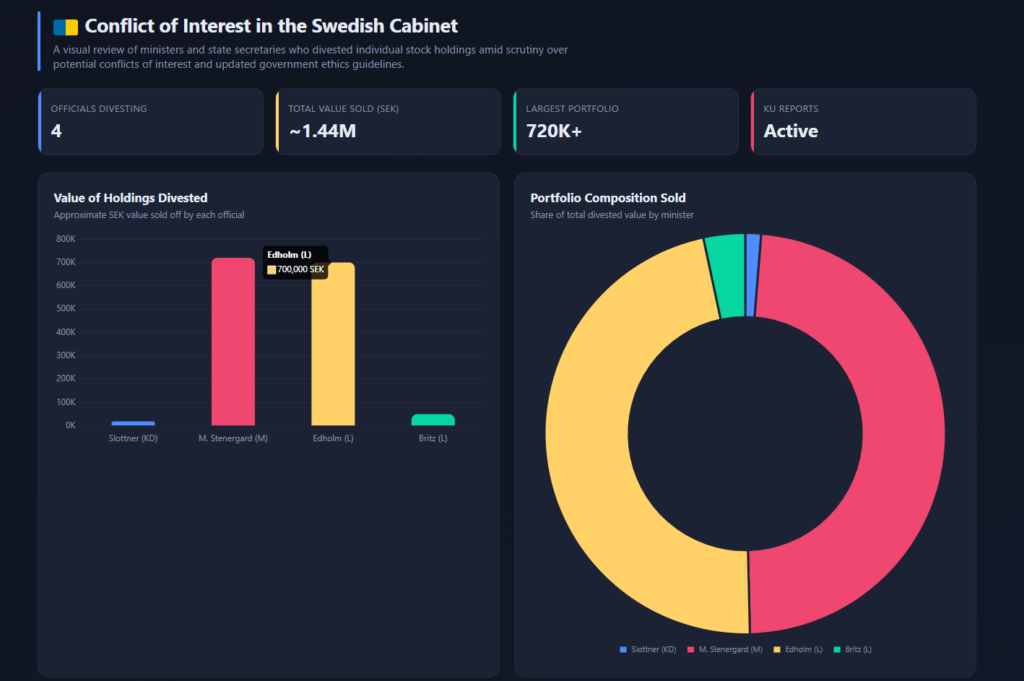
– Investigative reporting by Ekot flagged a series of ministers’ shareholdings that overlapped with government decisions. Among the examples: Erik Slottner sold a roughly SEK 19,000 stake in wind developer Eolus after acknowledging he had failed to report a conflict of interest related to decisions about wind‑farm permitting timelines.
– Ekot also revealed that, while serving as Minister for Migration, Maria Malmer Stenergard purchased just under SEK 10,000 in shares of defence supplier Mildef at a time Sweden was negotiating a major combat‑vehicle procurement. Although Mildef was not directly a party to the government decision, the overlap prompted scrutiny; Malmer Stenergard subsequently sold all personal shareholdings and moved to investing via funds.
– Other ministers named in the review included Johan Pehrson and Mats Persson, who have since left office. In response to the coverage, the Government Offices revised their guidelines in December, clarifying that ministers should often refrain from holding shares and must not participate in the preparation or decision‑making of matters involving companies in which they have a stake. Following the update, Minister Lotta Edholm divested her holdings and described the guidance as “highly reasonable.”
Why this matters now
Political‑economic intersection: The scrutiny comes at a moment of intensified political sensitivity. Defence procurement has risen sharply in strategic importance since Russia’s invasion of Ukraine, and renewable energy projects remain politically contentious at the local and national levels. When public servants own stakes in affected firms, legitimacy and process integrity are immediately called into question.
Market and investor implications: Even modest personal holdings can create outsized reputational risk for companies, especially smaller issuers whose fortunes are tightly linked to governmental decisions. Institutional investors and boards must factor political‑risk spillovers into governance and stewardship practices.
Governance signal: Nordic countries are prized internationally for predictable, transparent institutions. These episodes risk eroding that comparative advantage unless addressed decisively, through both clearer rules and robust disclosure practices.
Nordic and international context
The Nordic region traditionally emphasizes high standards of public‑sector integrity and transparency. Yet practices differ: some jurisdictions routinely require blind trusts, cooling‑off periods or full divestment for senior officials; others rely on disclosure and recusal. Sweden’s recent guideline revision moves it closer to the more precautionary approaches found elsewhere in the region, but the patchwork of voluntary and statutory requirements across Europe means cross‑border firms and investors still face uneven rules.
For global investors, the lesson is familiar: political exposures in small, open economies can have systemic effects on securities and contracts, particularly in strategic sectors such as defence, energy and infrastructure.
Business implications — risks and opportunities
Risks
Procurement and contract risk: Vendors may face renewed scrutiny or contract delays where officials’ holdings create perceived conflicts, potentially affecting project timing and valuations.
Reputation: Firms associated with implicated ministers may suffer reputational damage that depresses investor sentiment and complicates partnerships.
Regulatory uncertainty: Abrupt changes in ministerial behaviour and advisory guidelines can produce second‑order regulatory and policy shifts, which add implementation risk for long‑horizon projects.
Opportunities
Governance premium: Companies that pre-emptively adopt stringent conflict‑management practices and transparent engagement policies can differentiate themselves to institutional investors and public buyers.
Product and advisory services: Demand is likely to grow for compliance, disclosure and third‑party monitoring services, including digital platforms that automate conflict screening and public registries.
Market discipline: Heightened scrutiny could accelerate consolidation and professionalisation in sectors where small public contractors previously relied on political relationships.
Policy and corporate responses that matter
Standardise disclosures: Sweden should consider a central, machine‑readable registry of senior officials’ holdings and historically mandated reporting windows to accelerate conflict detection.
Move beyond ad hoc guidance: Formal rules on blind trusts, divestment thresholds and mandatory recusals provide clearer expectations than discretionary guidance alone. Any framework should be proportionate, protecting officials’ rights while preserving institutional integrity.
Digitalise conflict checks: Invest in interoperable data systems that cross‑reference procurement pipelines with declared interests and automate flagging for human review. This reduces both oversight failures and the perception of impropriety.
Corporate housekeeping: Boards and investor stewards should incorporate political exposure screening into routine risk assessments, with specific playbooks for managing adverse publicity and engagement.
The strategic takeaway for decision‑makers
The Ekot revelations are not simply a domestic political story: they illuminate how personal financial interests intersect with policy decisions that have material consequences for markets, national security and sustainability transitions. Restoring and preserving Scandinavian governance advantages requires a blend of institutional reform, technological enablement of transparency, and corporate discipline. For international investors and executives, the episode is a reminder to build political‑risk hygiene into due diligence and portfolio stewardship.
Conclusion
Sweden’s post‑Ekot divestments and revised guidelines represent an institutional course correction. The episode underscores a broader principle relevant to Nordic and global leaders: in an era of heightened geopolitical tension and active capital markets, the credibility of public decision‑making is an economic asset. Protecting that asset calls for clear, enforceable conflict‑of‑interest frameworks, digital tools that make oversight practical, and corporate governance that anticipates political scrutiny rather than reacts to it.
Editorial Outlook
For a follow‑up feature, Nordic Business Journal will investigate comparative mechanisms across the Nordics and selected European peers for insulating public decision‑making from private financial interests. The piece will examine the efficacy of blind trusts, mandatory divestment thresholds, centralized digital registries and automated conflict screening—assessing which models most effectively preserve market confidence without deterring public service. The investigation will include interviews with institutional investors, compliance technologists, ethicists and former ministers to map pragmatic policy choices and their market impact.
Reader engagement
Nordic Business Journal invites readers — executives, investors, policymakers and entrepreneurs — to share perspectives or propose collaborations on this topic. Contact our editorial team for data briefings, to recommend sources, or to discuss partnerships and events focused on governance, public‑sector transparency and sustainable investment in the Nordic region.