Denmark’s establishment of a centralised military AI centre signals a pivotal shift in Nordic defence architecture. As NATO’s newest unified bloc sharpens its technological edge, the region is crafting a distinct model—one that fuses cutting-edge capability with sovereign control and ethical guardrails.
The Danish Armed Forces have officially inaugurated their centralised AI centre under Defence Command. This launch arrives amid a multi-billion kroner surge in defence AI investment across the Nordic region. The catalyst is clear: Finland and Sweden’s NATO accession has redrawn the regional security map. For the first time in 500 years, the entire Nordic theatre operates under a unified command structure. Consequently, the region’s defence establishments are racing to build integrated, AI-enabled capabilities that match the geopolitical moment.
The implications extend far beyond national borders. Denmark, Norway, Sweden, and Finland are constructing an interconnected defence ecosystem. Their respective AI centres are being designed to communicate seamlessly, creating a collective technological deterrent that far exceeds any single nation’s weight. Yet beneath the strategic ambition lies a carefully calibrated balance—between operational aggression and ethical constraint, between sovereign independence and allied interoperability, and between domestic innovation and external dependency.
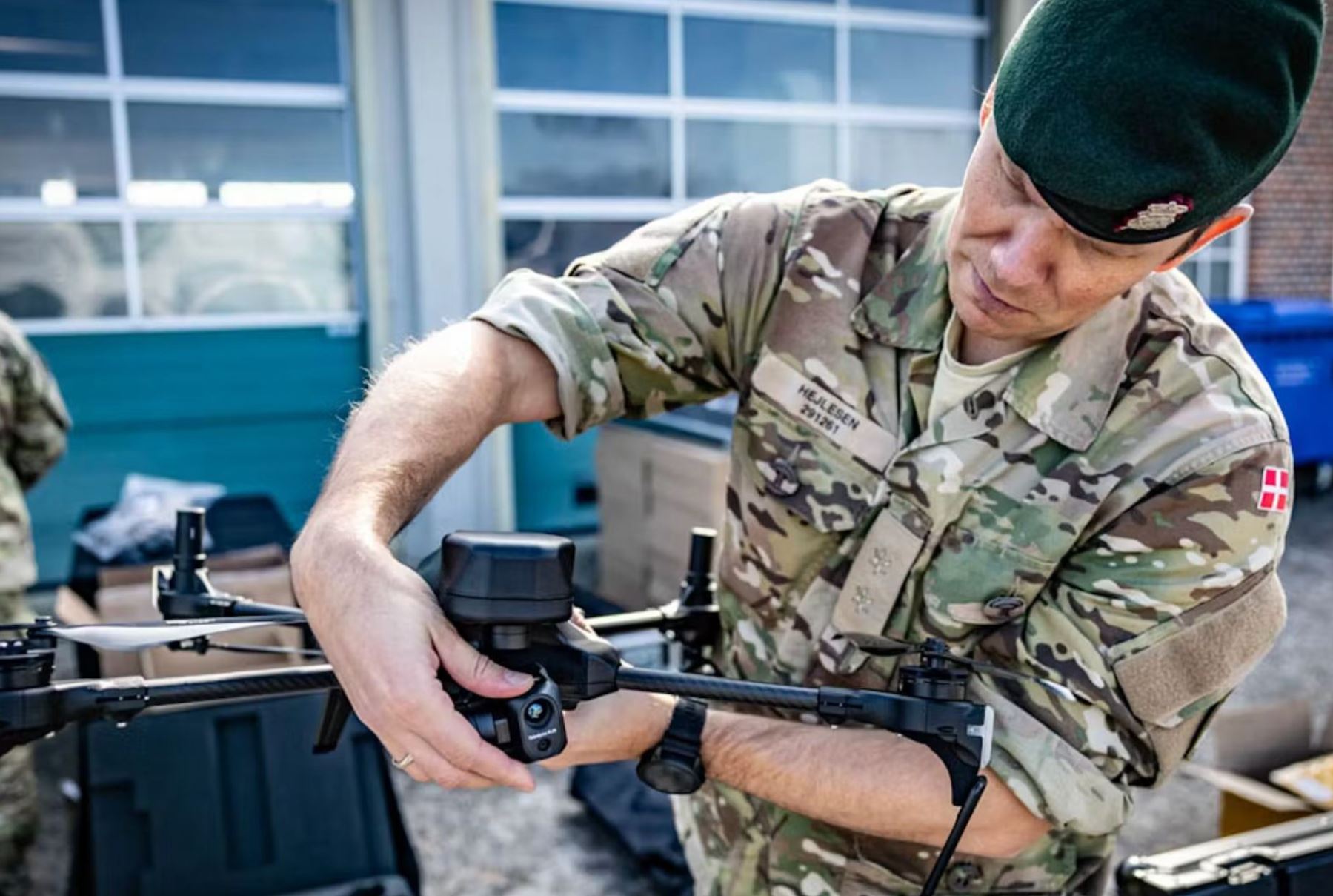
Denmark’s Blueprint: Targeted Integration
Denmark’s military AI framework centres on three clear national priorities.
The New AI Centre operates directly under Defence Command. Its mandate is focused: increase frontline combat power while ensuring the military stays ahead of emerging warfare technology. Unlike some allies, Denmark has resisted the temptation to scatter AI capabilities across branches. Instead, a single hub coordinates integration, reducing redundancy and strengthening oversight.
Maritime Domain Awareness reflects geographic reality. Denmark controls critical chokepoints—the Baltic Sea approaches and the Greenland-Iceland-UK gap. Vast maritime territories demand constant surveillance. AI systems now provide continuous, real-time monitoring that would be impossible through traditional means.
The Paris Declaration Guardrail distinguishes Denmark’s approach. By officially joining this initiative on maintaining human control over AI-enabled weapons, Denmark ensures that a human operator retains legal and practical responsibility for any kinetic decision. This is not merely ethical signalling. It is a deliberate architectural choice that shapes procurement, training, and doctrine.
Industrial Synergy further strengthens the model. Rather than relying exclusively on foreign technology, the Danish Armed Forces are leveraging domestic aerospace expertise. Companies such as Terma are integrating AI directly into command-and-control systems and air defence networks. This approach builds industrial capacity while keeping critical capabilities under national control.
The Nordic Model: A Networked Defence Ecosystem
Denmark is not building in isolation. The Nordic nations are merging their approaches to create a defence architecture of surprising scale.
Cross-Border Technical Interoperability is the foundational principle. When a Swedish radar detects an airspace anomaly over the Baltic, automated threat classification data pipes instantly to Danish and Finnish command nodes. The seamless flow of intelligence across borders transforms four national systems into a single, unified network. Each nation’s AI centre becomes a node in a larger, regional organism.
Norway’s Cyber Injection mirrors Denmark’s strategic intent. The Norwegian Armed Forces launched a one billion NOK data and AI department based at Kjeller. Norway’s focus centres on algorithmic speed—drastically reducing decision-to-action cycles when confronting sophisticated grey-zone and electronic warfare threats. The investment signals that small states can punch far above their weight when AI capabilities are concentrated effectively.
Sovereign Data Infrastructure represents the region’s most distinctive choice. The Nordics are deeply protective of data privacy and democratic values. Consequently, they have resisted total dependence on American Big Tech infrastructure. The New Nordics AI Centre, with its secretariat in Stockholm and funding from the Nordic Council of Ministers, pools high-value public and security datasets across borders. Localized, trusted language and prediction models are being built on home soil—a deliberate assertion of computational sovereignty.
The Energy Advantage is often overlooked yet strategically significant. AI model training demands enormous electrical power. The Nordics are leveraging their abundant wind and renewable energy grids to host liquid-cooled data hubs locally. This geographic infrastructure advantage grants true computational sovereignty while supporting broader climate commitments.
The Strategic Power of Military AI Centres
A military AI centre operates at the highest tier of national security relevance. It functions as the foundational engine for modern data-centric warfare.
Strategic Decision Advantage
Modern conflict moves at algorithmic speed. Consequently, military AI centers provide decisive advantages in three critical areas.
Conflict Simulation allows massive, real-time wargaming scenarios. AI systems generate and test hundreds of courses of action simultaneously, vastly outpacing human planners. Decisions that once required days of staff work can be evaluated in hours.
Intelligence Fusion unifies global surveillance, satellite imaging, cyber telemetry, and signals intelligence into a single operational picture. Commanders gain comprehensive situational awareness that was previously impossible.
Predictive Analysis identifies hidden patterns within adversarial deployments. AI alerts high command to impending grey-zone or kinetic movements before they materialise—transforming intelligence from reactive reporting into proactive foresight.

The Hub-and-Spoke Architecture
Effective military AI centres employ a hub-and-spoke model. A centralized hub establishes standard safety protocols, legal compliance frameworks, and procurement pipelines. Specialized capabilities then flow outward to individual branches, logistics wings, and frontline units. This architecture guarantees that every corner of the military operates with unified, secure, and current software. It also concentrates expertise where oversight is strongest.
Global Logistical Optimisation
AI centres generate operational advantages well beyond the battlefield.
Resource Forecasting anticipates shortfalls in ammunition, fuel, and supplies across vast theatres—often weeks before they occur. Logistics shifts from reactive replenishment to predictive allocation.
Autonomous Resupply networks are being designed to shield human personnel from dangerous transport corridors. Automated aerial, ground, and maritime vehicles reduce exposure while maintaining operational tempo.
Predictive Maintenance monitors high-value assets such as fighter jets and submarines. Algorithmic forecasting orders components prior to mechanical failure, maximising availability while minimising downtime.
Geopolitical Leverage
Possession of a superior military AI centre reshapes strategic calculations.
Algorithmic Deterrence forces adversaries to reconsider aggression. Potential opponents know that advanced AI can rapidly counter or neutralise offensive strategies, raising the cost-benefit analysis of confrontation.
Swarm Orchestration capabilities allow centres to field, guide, and adapt large masses of coordinated uncrewed systems. In contested environments, this massed, adaptive capability represents a decisive qualitative advantage.
However, these centres also introduce vulnerabilities. Physical data campuses and cloud systems supporting AI operations are treated as critical geopolitical targets. They face potential sabotage and state-sponsored cyber strikes. The very concentration that creates strength also creates new attack surfaces.
Strategic Outlook: Competing on a New Terrain
Denmark’s AI centre is more than a domestic initiative. It represents a deliberate bet on the future of warfare—and on the Nordic region’s capacity to compete in that future.
The model emerging from Stockholm, Oslo, Copenhagen, and Helsinki carries distinct advantages. Small populations and cohesive societies enable rapid institutional coordination. Geographic positions provide both strategic depth and surveillance challenges. Renewable energy infrastructure supports computational ambitions without entangling nations in carbon dependencies.
Yet significant questions remain. Can ethical guardrails coexist with operational necessity? Will sovereign data infrastructure achieve sufficient scale to compete with American and Chinese hyperscalers? How will Nordic nations manage the inevitable tensions between collective regional capability and national control?
The answers will shape not only regional security but the broader global debate over military AI governance. The Nordic model may well serve as a test case for how democratic societies harness artificial intelligence for defence while preserving human accountability and ethical constraint.
Editorial Outlook
Looking ahead, Nordic Business Journal will examine the civilian-military technology crossover as a critical enabler of regional defence capability. Denmark’s Centre for AI Innovation—a 600 million DKK initiative backed by NVIDIA—exemplifies this dynamic. How effectively can commercial AI breakthroughs be translated into military advantage? And what governance structures ensure dual-use technologies serve both economic growth and security objectives? This nexus of innovation, investment, and strategic policy warrants deeper investigation.
Additionally, the Arctic and Greenland surveillance challenge represents an emerging frontier. As polar ice retreats and new shipping routes open, Nordic nations face unprecedented monitoring responsibilities. AI-enabled surveillance across vast, remote territories tests both technological capability and institutional coordination. A future feature will assess how Denmark and its neighbours are building the intelligence architecture to meet this challenge.
Nordic Business Journal invites readers to connect for further insights, partnership opportunities, and strategic dialogue. Our editorial team welcomes perspectives from executives, investors, policymakers, and thought leaders navigating the intersection of technology, security, and sustainable growth. Reach us at editor@nordicbusinessjournal.com or follow our coverage at nordicbusinessjournal.com.
References.
- For Denmark’s newly established military AI hub under the Defence Command: (Forsvaret 2026).
- For Norway’s 1 billion NOK defence cyber and AI injection based out of Kjeller: (Nordic Defence Sector 2026).
- For the launch of the cross-border New Nordics AI Centre backed by the Nordic Council of Ministers: (AI Sweden 2025; Norden 2025).
- AI Sweden (2025). Nordic-Baltic AI Center launched with base in Stockholm. Available at: AI Sweden News (Accessed: 12 June 2026).
- Forsvaret (2026). Forsvaret etablerer AI-center [The Armed Forces establish AI centre]. Available at: Forsvaret Nyheder (Accessed: 12 June 2026).
- Norden (2025). New centre for artificial intelligence launched to promote use of AI in Nordics and Baltics. Nordic Council of Ministers. Available at: Norden News (Accessed: 12 June 2026).
- Nordic Defence Sector (2026). Norwegian Defence Invests One Billion in AI Centre. Available at: Nordic Defence Sector Article (Accessed: 12 June 2026).