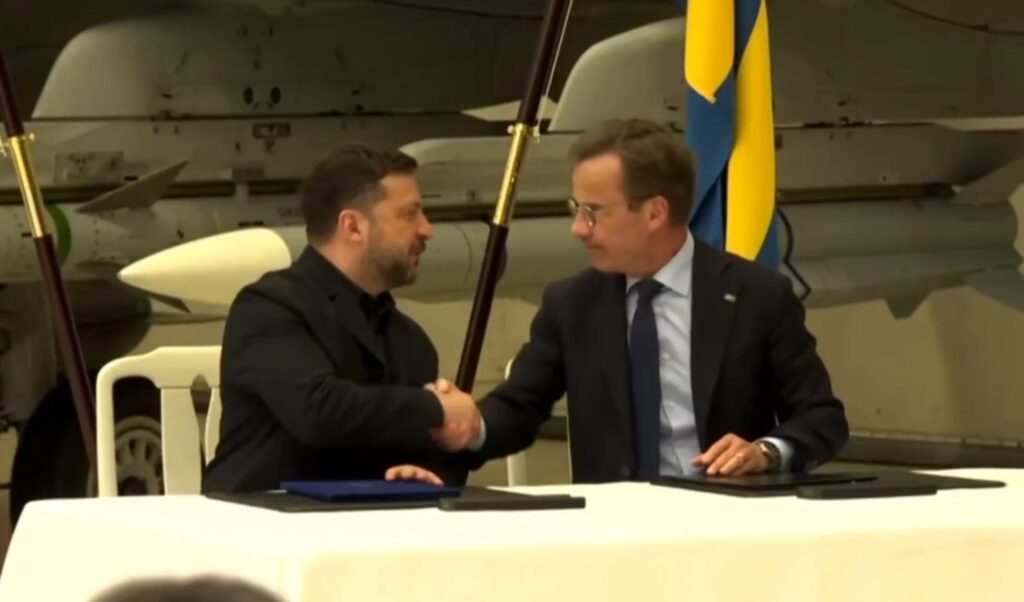
When Swedish Prime Minister Ulf Kristersson and Ukrainian President Volodymyr Zelenskyy stepped to the podium at Uppsala Air Base, the mainstream press immediately seized on the geopolitics: 36 high-performance fighter jets shifting the balance of power in Eastern Europe. The headlines blared with military aid figures and tactical timelines, painting a familiar picture of Western solidarity underwriting a frontline defence.
Yet, beneath the optics of bilateral assistance lies a masterclass in macro-financial engineering and industrial asset lifecycle management that general newsrooms completely missed. Look closely at the balance sheet of the deal, and the narrative flips from traditional military charity to a sophisticated example of financial arbitrage.
At the core of the agreement is a conditional asset-swap loop. Ukraine has committed to purchasing up to 20 next-generation Saab Gripen E/F models—with a long-term roadmap eyeing up to 150 units—capitalised by a €2.5 billion allocation carved directly out of the European Union’s €90 billion Ukraine Support Loan. But Stockholm’s stroke of genius is the structural tether: the immediate-term donation of 16 legacy Gripen C/D models is explicitly contingent on Kyiv signing this commercial purchase agreement for the newer E/F fleet.
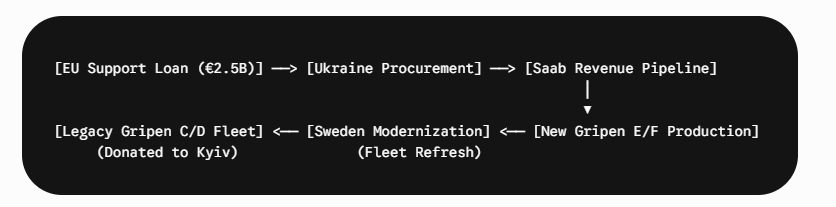
For Sweden, this framework functions as a brilliant risk-mitigation strategy. By leveraging external EU credit rather than local tax revenues, Stockholm secures a massive, long-term export anchor customer for Saab’s top-tier E-series, effectively guaranteeing production backlog stability through 2030 and beyond. Simultaneously, the Swedish government is using this injection of foreign procurement capital to fund the replacement of its own aging C/D models with brand-new E/F variants for the Swedish Air Force.
Ultimately, this is less about the mechanics of modern warfare and more about corporate outmanoeuvring. It demonstrates how a mid-tier defence manufacturer and an agile sovereign government can utilise transnational loan facilities to offload legacy inventory, completely modernise a domestic military grid, and underwrite a multi-billion-euro industrial expansion—all without straining the domestic taxpayer.
Key Analytical Takeaway: In high-stakes B2G (Business-to-Government) procurement, the product’s technical specifications are often secondary to the flexibility of the vendor’s financing architecture. Saab isn’t just selling hardware; they are exporting a self-funding operational ecosystem.
Target Costing: Why Operational Efficiency Beat Pure Performance
To understand why the Gripen triumphed in this procurement round, one must look past standard military specifications and evaluate the contract through the strict framework of Target Costing—an operations management methodology where the allowable cost of a product is strictly dictated by the marketplace and logistical constraints of its operating environment.
In high-intensity conflict zones, the “marketplace” is defined by extreme capital limitations and severe structural vulnerability. While the defence community frequently prioritises the cutting-edge capabilities of stealth platforms like Lockheed Martin’s F-35, the reality of active theatre operations highlights a massive operational bottleneck: infrastructure dependency.
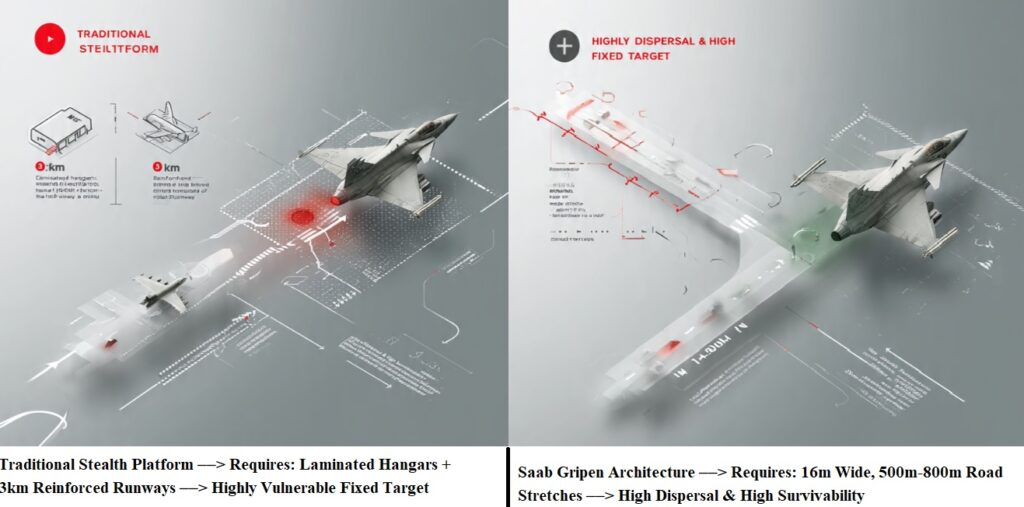
A platform that requires multi-million-euro, highly specialised, climate-controlled facilities and 3-kilometer reinforced concrete runways introduces a critical single point of failure. These massive footprints are easily monitored via satellite and highly vulnerable to precision missile and drone strikes. An aircraft that cannot take off because its single, centralised runway is cratered yields a return on investment (ROI) of zero.
Saab’s engineering philosophy turns this dynamic on its head by engineering backward from harsh frontline realities, optimising two core operational metrics:
1. Capital Expenditure (CAPEX) Elimination via Dispersed Logistics
The Gripen was designed from its inception to support Sweden’s Bas 90 dispersed operational doctrine. It features robust Short Take-Off and Landing (STOL) capabilities, enabling it to operate from regular public highways and makeshift runways just 16 meters wide and 500 to 800 meters long. By utilizing existing civil infrastructure, Ukraine completely bypasses the massive capital expenditure normally required to build or repair fortified military airfields. Dispersal yields survivability; an adversary cannot easily target a fleet that treats any stretch of asphalt as a potential launchpad.
2. Operational Expenditure (OPEX) and Lifecycle Cost Optimisation
The true genius of the Gripen’s design lies in its ultra-lean Total Cost of Ownership (TCO) and rapid turnaround cycle. The aircraft can be fully refuelled, rearmed, and inspected for its next sortie in roughly 10 minutes under ideal conditions.
| Metric / Requirement | F-35A | JAS 39 Gripen E/F |
| Estimated Cost Per Flight Hour (CPFH) | $33,000 – $46,000+ | $10,000 – $22,000 |
| Turnaround Crew Requirement | Highly specialized technical teams | 1 Tech Supervisor + 5 Conscript Airmen |
| Engine Replacement Window | Days / Specialized depot required | Under 60 minutes in the field |
By driving down the maintenance footprint, Saab minimises the human asset bottlenecks that plague complex western hardware. The system is intentionally engineered for simplicity—allowing basic Line Replaceable Units (LRUs) to be swapped out rapidly by mechanics with minimal specialised training.
By applying strict Target Costing to the platform’s lifecycle, Sweden didn’t just deliver an advanced piece of machinery to Ukraine; they provided a highly sustainable operational model that maximises combat availability per euro spent, turning a procurement decision into a masterclass in asset efficiency.
Key Analytical Takeaway: Superior engineering isn’t measured by adding features until nothing more can fit; it is defined by stripping away operational friction until the system can run seamlessly in the harshest possible environment – core aspect of Target costing.
The Transnational Industrial Footprint: The Anglo-Nordic Connection
A common pitfall in mainstream industrial analysis is treating sovereign defence procurements as zero-sum, localized transactions. In the case of the Ukraine-Sweden Gripen deal, general media outlets routinely frame the €2.5 billion contract as a purely bilateral economic injection into Stockholm’s domestic industrial base. However, evaluating the manufacturing architecture of the JAS 39 Gripen E/F reveals a highly integrated, transnational supply chain where British aerospace engineering serves as a critical structural pillar.
Far from being a localized Nordic product, approximately 35% to 37% of the Gripen E/F’s total component value is manufactured directly in the United Kingdom. This dense co-development network means that Ukraine’s macro-financial procurement acts less like a single-nation transaction and more like a pan-European industrial stimulus package.
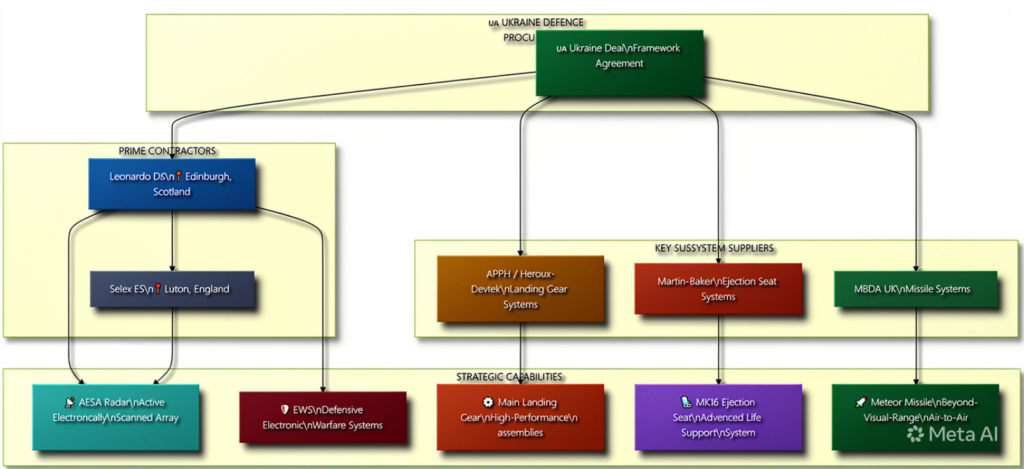
The division of specialised tier-one hardware within the aircraft highlights the extent of this cross-border integration:
- Sensor and Avionics Core: The heart of the Gripen E’s combat awareness—the Raven ES-05 Active Electronically Scanned Array (AESA) radar—is entirely designed and fabricated by Leonardo UK at their Edinburgh facility.
- Electronic Warfare Systems: The aircraft’s advanced defensive shielding and electronic countermeasure suites are driven by hardware developed at Leonardo’s site in Luton.
- Structural Mechanics: Critical physical sub-assemblies, including the specialized landing gear systems, are manufactured by British aerospace firms like APPH (Héroux-Devtek), while the pilot survivability systems rely exclusively on Martin-Baker’s world-standard MK16 ejection seats.
- Strategic Munitions Pipelines: The primary offensive capability of the platform is tied directly to the Meteor beyond-visual-range air-to-air missile, an international project heavily anchored by MBDA UK.
From a management and labour perspective, this deep industrial integration carries massive macroeconomic weight. Independent economic assessments indicate that British participation in the ongoing Gripen ecosystem generates between £1.1 billion and £3.3 billion in gross value added, directly sustaining roughly 4,000 to 5,700 highly skilled engineering and tech manufacturing jobs across the UK, alongside hundreds of specialised small and medium-sized enterprises (SMEs).
By distributing more than a third of the platform’s industrial footprint to the UK and heavily relying on broader European sub-tier networks, Saab has effectively insulated itself from the geopolitical bottlenecks that frequently delay unilateral American defence exports. For the Nordic Business Journal, the strategic takeaway is clear: the deal is a masterclass in building cross-border corporate alliances, allowing a mid-tier manufacturer to secure global market access by turning a national procurement project into a shared, pan-European industrial asset.
Key Analytical Takeaway: Modern industrial solvency is rarely achieved in isolation. By distributing its manufacturing footprint across strategic allied borders, Saab didn’t just build a supply chain—they engineered a built-in political and economic coalition that underwrites their commercial survival.
Strategic Takeaways for Management and Procurement
The architecture of the Sweden-Ukraine Gripen agreement extends far beyond the realm of defence economics; it offers a compelling framework for modern industrial procurement, corporate strategy, and ecosystem management. For executives and operations analysts operating in capital-intensive, high-velocity environments, three core strategic principles emerge from this transaction.
1. The Power of Financial Architecture over Raw Specifications
In high-stakes Business-to-Government (B2G) and complex enterprise procurement, technical or performance superiority is a baseline requirement, not a differentiator. The deal proves that the real competitive advantage lies in the vendor’s ability to architect a flexible, multi-layered financial solution.
- The Lesson: By tying immediate asset offloading to future commercial backlog commitments—and funding it via transnational loan facilities (the EU Support Loan)—Saab and the Swedish government created a self-sustaining asset loop.
- Application: When competing against market dominant conglomerates, mid-tier market players must pivot from pitching product features to designing comprehensive, risk-mitigated balance sheet solutions for the buyer.
2. Operational Solvency as a Core Value Metric
Mainstream market analysis often defaults to evaluating products through a “maximum performance” lens. The Gripen’s triumph over structurally heavy alternatives underscores the strategic value of designing for Total Cost of Ownership (TCO) and Infrastructure Flexibility.
- The Lesson: By focusing on strict Target Costing, Saab intentionally eliminated massive Capital Expenditure (CAPEX) requirements (specialized concrete runways and hangars) and optimised Operational Expenditure (OPEX) via ultra-lean field turnaround loops.
- Application: In unstable or resource-constrained markets, resilience, low infrastructure dependency, and rapid maintenance turnarounds consistently outperform high-maintenance, capital-intensive solutions. Supply chain agility trumps raw capacity.
3. Co-Opetition and Transnational Ecosystem Insulation
Saab’s deliberate strategy to distribute nearly 37% of the platform’s component value to British engineering hubs (such as Leonardo and MBDA UK) demonstrates how to build structural resilience into a supply chain.
- The Lesson: Instead of pursuing complete vertical integration or purely national manufacturing, Saab engineered a distributed, cross-border industrial ecosystem. This shared footprint aligns the economic and political incentives of multiple nation-states, creating a built-in lobby for the platform’s long-term commercial survival.
- Application: Modern operations managers should view supply chain distribution not just as a cost-allocation tool, but as a strategic mechanism to build political, legal, and operational insulation against localized bottlenecks and systemic shocks.
Conclusion: The Agility Dividend
The ultimate executive takeaway from the Gripen loop is a lesson in corporate positioning. A middle-tier manufacturer cannot defeat a global behemoth by matching their capital spend or raw scale. Instead, success is captured by leveraging agility—by offering the marketplace an integrated, highly cooperative partnership model that transforms a rigid transactional sale into a shared, sustainable, and resilient macroeconomic asset.
References:
- Government of Sweden: Sweden to sell Gripen E/F fighter aircraft to Ukraine 28th May 2026
- TVP world: Ukraine to get Swedish fighter jets in major defence deal
- Saab- How Gripen can be cost effective 11 November 2020
- Swedish Television – Ukraina köper 20 JAS Gripen-plan av Sverige – 2006-05-2026
- John Granlund: Säkerhetsreporter (Defence reporter) Swedish TV
- Defence Industry Europe: The vital role of the UK in the Gripen fighter programme (2024)
- BAE System: International industry collaboration on future combat air capability takes a significant step forward (2020)
We welcome dialogue with executives, investors, and policymakers shaping the next phase of Nordic economic strategy. For insights, partnership opportunities, or commissioned research on defence, innovation, and investment opportunities, please connect with our editorial and advisory teams at insights@nordicbusinessjournal.com or through our executive briefing network.
By Kwah Driscole G. He holds a PhD in Management Science from the University of Southampton, UK. He has a strong background in the Japanese Management system of which Target costing is one of them. His MPhil (University of Exeter, UK) and MSc. Göteborg University were based on target costing examined from different perspectives.