For decades, the Swedish krona (SEK) and the Norwegian krone (NOK) have moved in relative tandem, underpinned by shared regional stability, integrated supply chains, and synchronized Nordic welfare models. That era of monetary symmetry has fractured.
In a striking reversal of recent historical trends, the SEK/NOK exchange rate has experienced pronounced downward pressure, sliding from 1.09 NOK per SEK at the start of 2026 to breach parity at approximately 0.99 by early June. This divergence is not merely a cyclical market fluctuation; it is a symptom of deeper structural shifts. It reflects the collision of divergent monetary policies, the renewed premium on energy security, and the vulnerabilities of export-driven economies in an increasingly fragmented global trade environment.
For senior executives, institutional investors, and policymakers, understanding this decoupling is no longer optional. It is a prerequisite for accurate capital allocation, risk management, and strategic forecasting in the Nordic region.
The Monetary Policy Wedge
The immediate catalyst for this cross-currency realignment is a widening divergence in central bank doctrine. While both nations share a commitment to price stability, their domestic economic realities have forced them onto opposing trajectories.
The Swedish Riksbank, confronted with cooling domestic growth and inflation metrics retreating toward its target, has adopted a decidedly dovish posture. By maintaining stable or lower rates, the central bank is attempting to cushion a softening domestic economy and support its vital manufacturing and technology sectors.
Conversely, Norges Bank has taken a resolutely hawkish stance. Driven by sticky core inflation (CPI-ATE holding at 3%) and elevated domestic wage growth, Norway’s central bank recently executed a surprise rate hike to 4.25%. Crucially, forward guidance signals a willingness to tighten further toward 4.5% if inflationary pressures persist. This unexpected yield premium has acted as a powerful magnet for yield-seeking capital, providing immediate, structural support to the Norwegian krone.
Energy Security as a Macroeconomic Moat
Beyond interest rates, the divergence highlights a fundamental reassessment of what constitutes a “safe-haven” asset in the 2020s.
As geopolitical friction in the Middle East and broader global transit corridors continues to inject volatility into energy markets, crude oil spot prices have remained persistently elevated. In this environment, Norway’s status as Europe’s secure, reliable energy powerhouse has transformed the NOK into a classic commodity-backed defensive currency. Capital flows naturally gravitate toward jurisdictions that offer organic hedges against global supply shocks.
Sweden, despite its global leadership in green technology, digital innovation, and advanced manufacturing, lacks this inherent energy buffer. As an intensely export-reliant economy, the SEK is highly sensitive to global risk appetite. During periods of market anxiety, international investors historically rotate out of smaller, cyclical currencies like the krona in favour of global anchors, primarily the US Dollar (USD). This dynamic creates a dual-pressure mechanism on Swedish assets: capital outflows coupled with a deteriorating terms-of-trade outlook.
The Dollar Magnet and Export Vulnerabilities
The broader international market context further exacerbates Sweden’s vulnerability. The US dollar continues to dominate cross-border trading, buoyed by stubbornly high US interest rates and its status as the preeminent global defensive asset amid geopolitical uncertainty.
This “USD magnet” effect is particularly punishing for open, trade-reliant economies. Escalating global trade protectionism and shifting Western tariff architectures pose a direct threat to industrial supply chains. While central banks may view the direct macroeconomic impact of localized tariffs as manageable, the indirect sentiment damage is swift. Market participants are increasingly shorting the SEK, pricing in the reality that Sweden’s growth model is more exposed to global trade friction than Norway’s resource-insulated, domestically buffered economy.
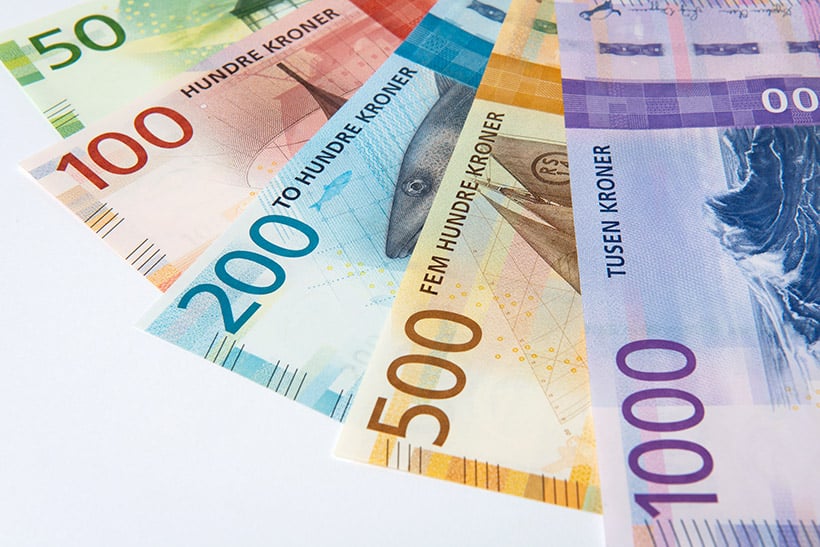
See analysis of Nordic currencies Link open in a new tab.
Strategic Horizon: Navigating the Parity Threshold
Looking ahead, market participants must navigate a landscape defined by high-stakes data checkpoints and volatile geopolitical variables.
The Near-Term Outlook (1–4 Weeks)
The immediate horizon is dominated by central bank signalling. Norges Bank’s upcoming monetary policy meeting on June 18 will be closely scrutinized for its updated rate path. Should the bank reinforce its hawkish credibility, the SEK/NOK pair will likely struggle to reclaim territory above parity. Concurrently, any dovish rhetoric from the Riksbank ahead of its August policy cycle will effectively cap any meaningful recovery in the Swedish krona.
The Medium-Term Horizon
Two structural themes will dictate the medium-term trajectory:
1. The Energy-Inflation Feedback Loop: If global shipping bottlenecks and trade corridor disruptions persist, sustained high commodity prices will continue to underpin the NOK. For Sweden, a prolonged weak krona threatens a painful scenario of “imported inflation,” wherein the cost of vital imports rises. This could corner the Riksbank, forcing an uncomfortable choice between supporting growth and combating inflation.
2. Technical and Behavioral Battlegrounds: The psychological parity level of 1.00 SEK per NOK has become a fierce technical battleground. Market microstructure suggests that algorithmic and technical traders are actively defending this threshold, pointing to a summer characterized by choppy, volatile horizontal swings as macroeconomic data trickles in.
Conclusion
The current dynamic between the Swedish krona and the Norwegian krone is a masterclass in how macroeconomic architecture dictates currency resilience. Until global inflation cools sufficiently to allow Norges Bank to ease its tightening cycle, or until geopolitical tensions subside enough to catalyse a robust global manufacturing rebound, the Norwegian krone retains the fundamental upper hand.
For business leaders and investors, the era of treating Nordic currencies as a homogeneous bloc is over. Strategic positioning now requires a nuanced understanding of how energy security, monetary divergence, and global trade fragmentation will continue to reshape the region’s economic landscape.
Editorial Outlook
In our next issue, Nordic Business Journal will explore:
“The Hedging Imperative: How Nordic Multinationals are Restructuring Capital Allocation in a Fragmented Currency Environment.”
As the SEK/NOK divergence persists, we will examine the treasury strategies of leading Swedish and Norwegian corporations. This follow-up will analyse how CFOs are utilizing forward contracts, regional supply chain nearshoring, and dynamic pricing models to protect margins against prolonged currency volatility and imported inflation.
Connect with Nordic Business Journal
Stay ahead of the curve.
For senior executives, investors, and policymakers seeking rigorous, forward-looking analysis of the Nordic and broader European business landscape, Nordic Business Journal is your essential partner.
To discuss partnership opportunities, access our proprietary market intelligence reports, or contribute your insights to our editorial dialogue, please contact our editorial desk at insights@nordicbusinessjournal.com or visit www.nordicbusinessjournal.com/connect.
Elevating the discourse. Informing the future of Nordic business.