As global faith-based nationalism reshapes democracies, Sweden’s upcoming 2026 election reveals a uniquely Nordic strain of cultural Christianity—one that carries profound implications for governance, investment risk, and social cohesion
Executive Summary
In September 2026, Sweden will hold its first general election since joining NATO, in a political landscape where the boundary between cultural heritage and religious identity has become dangerously porous. For decades, Sweden occupied the extreme upper-left corner of the World Values Survey’s cultural map—a beacon of secular-rational values and self-expression unmatched anywhere on earth. Yet beneath this surface, a quiet but consequential shift is underway. The Sweden Democrats and Christian Democrats are selectively weaponising Christian cultural identity not as theology, but as a political instrument for defining national belonging, immigration policy, and the very meaning of Swedishness.
For business leaders, investors, and policymakers, this is not merely a cultural curiosity. It is a governance risk with measurable implications: for regulatory stability, talent mobility, foreign direct investment, and Sweden’s positioning as a liberal, open economy in an era of geopolitical fragmentation.
The Baseline: Swedish Exceptionalism and the Secular Consensus
To understand what is changing, one must first grasp what Sweden was. The World Values Survey consistently ranks Sweden among the most secular and individualistic societies globally, with exceptionally high scores on both secular-rational and self-expression values. Church attendance has remained minimal—just 4.5% of Swedes attend services monthly—and trust in religious institutions stands at a mere 21%. The Church of Sweden was formally disestablished in 2000, and for most Swedes, Christianity functions as cultural heritage rather than lived faith: baptisms, weddings, and funerals in medieval churches are social rituals, not theological commitments.
This secular consensus has long been a competitive advantage. It underpinned Sweden’s reputation for rational governance, gender equality, and evidence-based policy—qualities that attracted global talent and capital. But that consensus is now under strain.
Recent data tell a more complex story. Support for a Christian-oriented society has risen from approximately 20% in 2014 to 25% in 2020. Among young Swedes, church attendance doubled between 2020 and 2024, from 17% to 34%, while belief in God in this demographic climbed from 20% to 34%—the highest level since systematic data collection began in 2010. The Church of Sweden reported 14,000 new members in 2024, the highest in decades, with 2025 on track to exceed even that figure.
Crucially, as Professor Magnus Hagevi of Linnaeus University has demonstrated, this trend is not driven solely by immigration. Both native-born and foreign-born young Swedes are following the same trajectory, suggesting a generational shift rather than a demographic one.
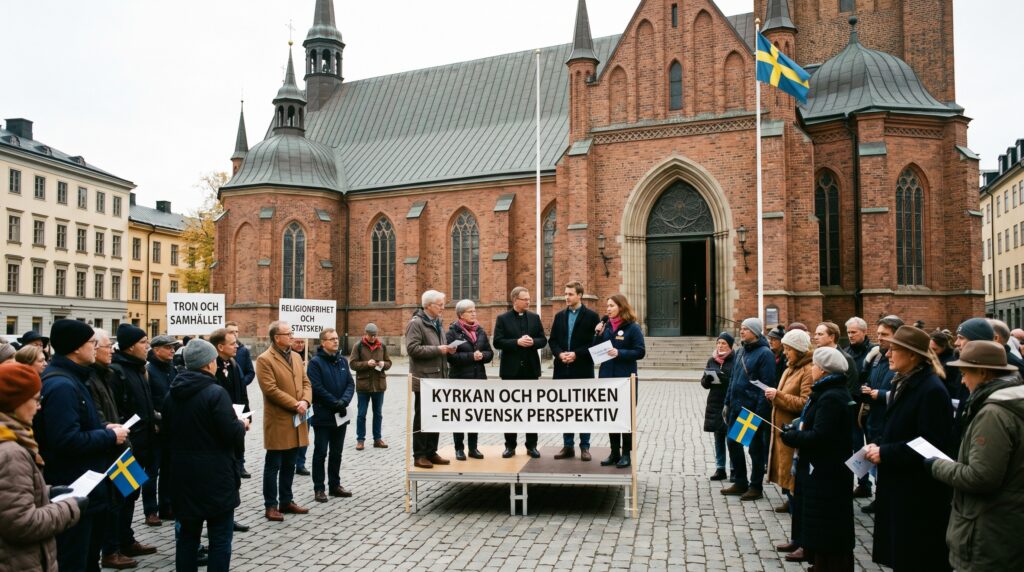
The Global Context: Three Models of Religious Mobilisation
Religious nationalism is not a Swedish invention. It is a global phenomenon, but its mechanics vary dramatically by region. Understanding these variations is essential for assessing how the Swedish variant may evolve—and what risks it presents.
The American Model: Overt Pastoral Alignment
In the United States, religious mobilisation remains explicitly theological. Politicians quote scripture, surround themselves with evangelical leaders, and frame policy debates in terms of divine morality. This model depends on a population where religious belief remains high and churches function as independent power centres. In Sweden, where overt theological displays alienate the secular majority, direct importation of this model is politically suicidal.
The Eastern European Model: Civilizational Christianity
In Poland, Hungary, and Russia, leaders position their nations as bulwarks of “Christian Europe” against multiculturalism, globalisation, and liberal values. Religion becomes a civilizational marker rather than a personal faith. This model is far more transferable to Sweden. It requires no mass religious revival—only the strategic framing of “Judeo-Christian values” as synonymous with Swedish cultural identity.
The Global South Model: Theocratic Populism
In parts of Africa, Latin America, and South Asia, faith networks function as parallel social safety nets and direct political mobilisation machines. This model is structurally incompatible with Sweden. The robust welfare state leaves no vacuum for religious institutions to fill, and anti-establishment populism in Sweden channels through secular nationalism, not clerical authority. The Swedish variant, then, is most likely to resemble the Eastern European model: a culturalised Christianity that operates as identity politics, not theology.
The Political Machinery: How Faith Becomes Strategy
Three analytical lenses reveal how religious identity is being operationalised in the 2026 electoral cycle.
1. Strategic Value Voting and the Free-Church Constituency
Sweden’s free-church communities (frikyrkor)—Pentecostal, Baptist, and other evangelical denominations—represent a small but electorally potent force in specific municipalities. In an era of narrow parliamentary majorities, these communities hold genuine swing-voter power. The Christian Democrats, under Ebba Busch, have explicitly targeted this constituency while simultaneously moderating their theological rhetoric for broader appeal.
In 2025, Busch called for a public ban on the niqab and burqa, framing it not as religious policy but as a defence of “fundamental Swedish values” and gender equality. This is textbook cultural Christianity: the invocation of religious identity to advance a secular political agenda, while positioning Islam as the civilizational “other.”
2. The “Culture War” Framing
Religious symbols are increasingly weaponized to create polarization. Church bells, school prayer debates, and religious dress codes are deployed not as matters of faith but as boundary markers between “us” and “them.” The Sweden Democrats, now the second-largest party in the Riksdag and providing confidence-and-supply to the Kristersson government, have mastered this framing.
Party leader Jimmie Åkesson has described Christianity as a “system of norms” rather than a religion, and has called for the demolition of mosques spreading “anti-democratic, anti-Swedish, homophobic, or anti-Semitic propaganda.” This is not religious populism in the traditional sense; it is the culturalisation of religion—a selective appropriation of Christian identity to define national belonging while marginalising minority communities.
3. The Secular Backlash Risk
Here lies the critical tension. Because Sweden’s electorate remains overwhelmingly secular, any party that leans too heavily into explicit religious rhetoric risks a severe counter-mobilisation. The secular voter base views church-state separation as a foundational value, and any perceived importation of American-style religious politics triggers immediate resistance.
This creates a delicate calibration for political actors: they must invoke Christian cultural identity with sufficient strength to mobilise conservative voters, but with sufficient ambiguity to avoid alienating the secular centre. The rhetorical pivot from “faith” to “heritage,” from “God” to “tradition,” is not accidental—it is a strategic necessity.
The Rhetorical Audit: Reading the Campaign Trail
An empirical analysis of party platforms and public discourse reveals three distinct linguistic strategies:
The “Value” Pivot
Track the frequency with which terms like tradition, heritage, ethics, and values substitute for explicit religious language. This vocabulary allows politicians to appeal simultaneously to secular nationalists (who hear cultural preservation) and religious conservatives (who hear coded theological affirmation). In the 2026 campaign, this pivot is already visible in both Sweden Democrat and Christian Democrat communications.
Visual Legitimacy
Campaign imagery offers another diagnostic. Are secular politicians suddenly appearing at religious conferences, cultural festivals, or sacred sites? Such appearances project moral authority without requiring theological commitment. They signal alignment with “traditional values” while maintaining plausible deniability with secular voters.
Comparative Nordic Positioning
Sweden is not alone in this evolution. Denmark and Norway have seen similar, if less pronounced, trends. Finland’s recent survey data show a striking rise in religious belief among young men—from 35% in 2019 to 62% in 2024. The Nordic model of secularism is under pressure across the region, driven by geopolitical anxiety (Russia’s invasion of Ukraine), pandemic-era existential questioning, and the cultural dislocation of rapid demographic change.
For Sweden specifically, NATO accession in March 2024 has introduced a new variable. The alliance with historically Christian-majority nations, combined with the existential threat posed by Russia, has created fertile ground for civilizational framing—positioning Sweden as part of a “Christian West” defending itself against authoritarianism.
Business and Investment Implications
For the Nordic Business Journal readership, these trends carry tangible consequences:
Regulatory and Policy Risk
A government more heavily influenced by culturally Christian nationalism may pursue policies that affect sectors from education to healthcare to immigration-dependent industries. Restrictions on religious expression, changes to citizenship requirements, or shifts in cultural funding priorities could alter the operating environment for multinational firms.
Talent and Mobility
Sweden’s competitive advantage in attracting global talent has rested partly on its reputation for secular tolerance and gender equality. Any erosion of that reputation—whether through policy changes or shifting social norms—could affect recruitment in knowledge-intensive sectors.
Geopolitical Positioning
Sweden’s NATO membership has already shifted its foreign policy alignment. A more culturally Christian nationalist discourse could complicate relations with Middle Eastern trading partners, affect Sweden’s stance on EU enlargement, or influence its approach to migration from non-European markets.
Social Cohesion and Market Stability
Political polarisation around identity issues is not merely a cultural concern. It affects consumer confidence, social trust indices, and the long-term stability of the institutional framework that underpins Sweden’s economic model.
The Long View: Trends and Trajectories
Looking beyond the 2026 election, three scenarios merit consideration:
Scenario One: Contained Culturalisation
Religious identity remains a rhetorical tool for conservative mobilisation but does not translate into substantive policy change. Sweden maintains its secular governance framework, and the trend proves to be a cyclical political strategy rather than a structural shift. This is the baseline case for most business planning.
Scenario Two: Institutional Creep
Cultural Christianity begins to influence institutional design—changes to education curricula, cultural funding priorities, or church-state relations. This would represent a more significant departure from the post-2000 secular settlement and would require active risk assessment by firms with long-term Swedish exposure.
Scenario Three: Generational Reversal
The youth religious revival proves durable and deepens, creating a genuine constituency for faith-based politics. This would fundamentally reshape Swedish political culture over a 10–20 year horizon and would have profound implications for everything from family policy to foreign affairs.
The most probable near-term outcome is a variant of Scenario One, with selective elements of Scenario Two. The generational data are too preliminary to justify Scenario Three, but too striking to dismiss entirely.
Conclusion: Reading the Signals
Sweden’s 2026 election will not produce a theocracy. That is not the risk. The risk is subtler: the gradual, strategic transformation of religious identity from a private matter into a political weapon, deployed not to advance faith but to define who belongs—and who does not.
For decision-makers, the task is to read the signals beneath the surface. Watch not for Bible verses in stump speeches, but for the quiet substitution of “heritage” for “faith,” of “values” for “doctrine.” Monitor not church attendance, but campaign imagery. Track not theological debates, but the framing of Islam as civilisational threat.
Sweden’s secular exceptionalism was never merely a cultural preference; it was a governance model that underpinned economic openness, social trust, and institutional stability. Its erosion, however gradual, is a development with measurable business implications. The 2026 election will reveal whether that erosion is a passing political tactic or the beginning of a more profound transformation.
The world is watching. So should the boardroom.
The author is a contributing analyst to Nordic Business Journal, specialising in political risk, Scandinavian governance, and the intersection of identity politics and economic policy.