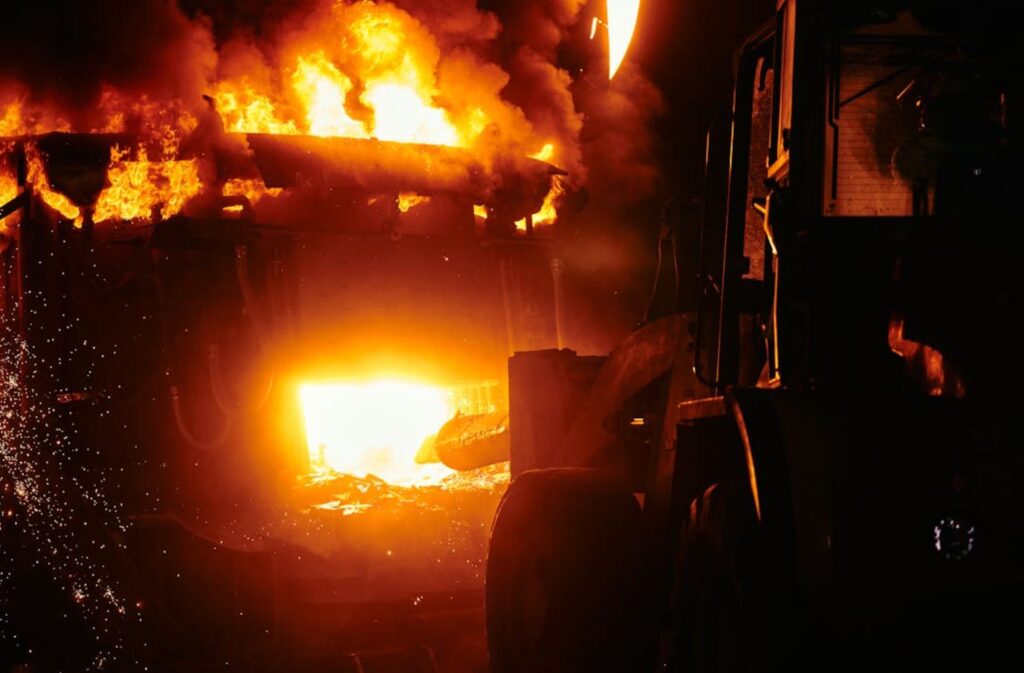
A Saturday afternoon fire outside Perstorp claimed 48,000 chickens and reduced a 90-meter poultry facility to ash. No human lives were lost, and emergency crews acted swiftly to contain the blaze before it reached adjacent silos and nearby woodland. But for the Nordic agricultural sector, the incident is far more than a local tragedy. It is a stark, real-world stress test of modern food production infrastructure, supply chain resilience, and risk management in an era of tightening margins and rising climate volatility.
The Incident, in Context
Shortly after 3:30 p.m., multiple public reports of thick smoke prompted an emergency response. Within eleven minutes, fire units arrived to a fully developed fire. Fourteen engines from four stations were deployed, focusing on containment rather than evacuation, a standard protocol in large-scale poultry operations where animal rescue is rarely feasible once flames take hold. Police have ruled out foul play, and the exact ignition source remains under technical review. What is clear, however, is the operational scale lost: 48,000 birds represent weeks of contracted production, feed inputs, and downstream processing capacity.
The Business Ripple Effect
Poultry is a tightly scheduled commodity. Unlike livestock that can be relocated or staggered to market, broiler production runs on rigid biological and logistical timelines. A single facility loss disrupts feed supply contracts, processing schedules, and retail commitments. In the Nordic context, where poultry margins have been compressed by energy price volatility, elevated feed costs, and stricter environmental compliance since 2023, incidents of this magnitude compound financial stress across regional networks.
Insurance implications are equally telling. Agricultural property claims in Sweden have risen steadily over the past three years, driven by electrical faults, ventilation system failures, and dry-season fire spread. The Perstorp blaze will likely accelerate premium recalibrations, particularly for older barn designs lacking compartmentalized fire barriers or early-suppression systems. Insurers are increasingly shifting from reactive indemnification to proactive risk-sharing, tying coverage terms to demonstrable prevention investments.
What’s Changed in 2026: Regulation, Technology, and Industry Response
As of spring 2026, Swedish authorities have published updated fire-safety guidelines for large-scale livestock buildings, emphasizing thermal monitoring, automated misting integration, and non-combustible cladding retrofits. The Swedish Board of Agriculture, in coordination with Nordic insurance consortia, now recommends biannual fire-risk audits for facilities housing more than 20,000 birds.
Industry data from 2024–2026 shows a marked pivot toward preventive infrastructure. Nordic agtech firms report a 30–40% increase in adoption of IoT-based heat and smoke detection arrays, with systems capable of triggering localized suppression before flames breach ventilation shafts. Municipal emergency planning has also evolved: several Swedish counties now maintain shared pre-incident mapping for agricultural sites, allowing faster tactical deployment and reducing collateral damage to surrounding ecosystems.
erhaps the most notable shift is cultural. Large poultry producers are no longer treating fire prevention as a compliance checkbox. It is being embedded into operational continuity planning, much like cybersecurity or supply chain diversification. Forward-looking operators are stress-testing single-point failures, renegotiating force majeure clauses, and partnering with regional fire services for joint drills.
Strategic Takeaways for Nordic Operators & Investors
1. Treat barn infrastructure as critical business assets. Retrofit priorities should focus on early detection, compartmentalization, and ventilation isolation. The cost of prevention is consistently lower than the compound loss of production, insurance deductibles, and contractual penalties.
2. Map supply chain exposure. Identify where single-facility failures could bottleneck processing or retail fulfilment. Diversifying contract volumes across geographically separated sites reduces systemic risk.
3. Engage insurers as risk partners, not just payers. Premiums are increasingly negotiable when operators can demonstrate sensor integration, staff training, and documented emergency protocols.
4. Factor climate and dry-season volatility into long-term planning. Nordic summers are trending warmer and drier, elevating wildfire adjacency risk. Land-use planning and brush clearance around agricultural perimeters are now operational necessities, not landscaping preferences.
The Perstorp fire is a sobering reminder that in modern agriculture, risk is rarely isolated. It travels through feed contracts, insurance pools, municipal response grids, and consumer supply lines. How Nordic agribusinesses prepare for the next spark will determine not just their balance sheets, but the resilience of the region’s food infrastructure.
What’s Next & How to Connect
Follow-up direction: In our next issue, we’ll examine how Nordic insurers and reinsurers are pricing climate and fire risk in agricultural portfolios, and why parametric insurance models are gaining traction among mid-sized producers. If your organization is navigating coverage renewals, risk-retention strategies, or agtech integrations, we want to hear from you.
Connect with us: Share your insights, case studies, or questions with our editorial team at editorial@nordicbusinessjournal.com or via LinkedIn @NordicBusinessJournal. Subscribe for deep-dive reporting on Nordic markets, supply chain resilience, and sustainable industry transformation.