
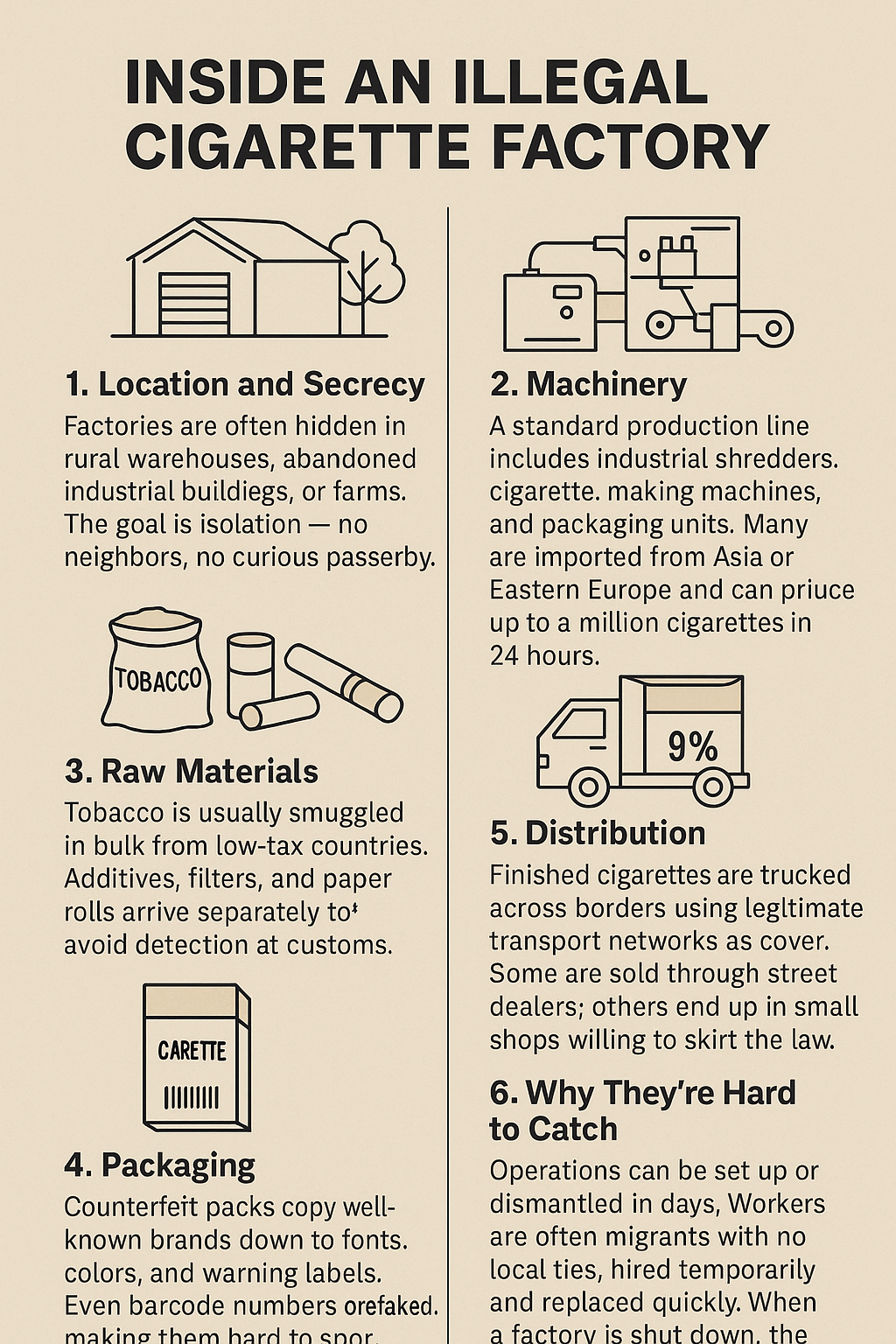
Organized crime has found a gold mine in Europe’s underground cigarette trade. The latest sign surfaced in the quiet Swedish town of Lövånger, where investigators uncovered a fully operational factory producing counterfeit cigarettes on an industrial scale.
“The key for this kind of operation is to stay under the radar. The market is likely the whole of Europe,” says Anna Lundström, crime prevention specialist at the Swedish Economic Crime Authority.
A Business Built on Tax Gaps
The math explains why criminals keep coming back. Producing a pack costs around two kronor. On the street, untaxed, it sells for 40–50 kronor. In legal shops, with full taxes applied, the same pack fetches 85 kronor or more. The gap is pure profit for criminal networks.
Factories like the one in Lövånger aren’t rare. Similar setups have been exposed across the EU, often producing near-perfect imitations of major cigarette brands. The counterfeit packaging mimics everything — from logos to health warnings — making them hard to distinguish from the real thing.
Millions Lost Every Day
In Lövånger, police seized massive quantities of tobacco and advanced machinery capable of churning out a million cigarettes a day. At that scale, Sweden alone loses 2.1 million kronor in tax revenue daily. Under Swedish law, tax losses above 600,000 kronor already qualify as serious tax crimes.
Five people are now suspected in connection with the operation, which prosecutors say was worth millions.
The Policy Trap
Rising cigarette prices — intended to reduce smoking — have a side effect: they push addicted smokers toward the black market. Many long-term smokers, unable to quit but unable to afford legal cigarettes, turn to cheaper illicit products.
Criminal groups understand this perfectly. Like drug cartels in Latin America, they invest heavily in infrastructure because the payoff is huge and the demand is constant.
What Comes Next
Lawmakers face a delicate balance. Raise taxes too high, and the black market thrives. Lower them too much, and public health goals suffer. The challenge is designing policy that cuts criminal profit without undoing decades of anti-smoking progress.
For now, Europe’s illicit cigarette factories keep running — quiet, hidden, and highly profitable — until the next police raid brings one into the light.
Here’s the sidebar piece — concise, factual, and written so it complements the main article without repeating it.