
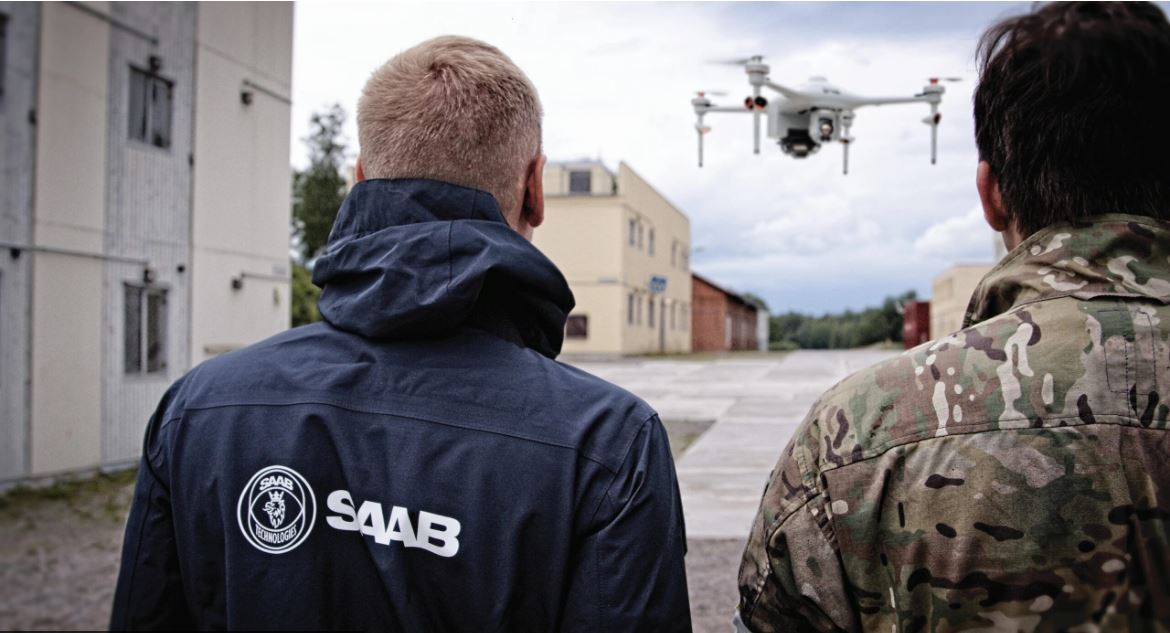
UMS Skeldar, a Saab-owned unmanned systems company, has begun flight testing at Norrköping Airport, strengthening Sweden’s foothold in the rapidly expanding drone sector. While little known outside defence circles, the company has become a credible international player with customers across Europe and beyond. Its expansion in Östergötland underscores how Sweden is broadening its aerospace cluster at a time when unmanned systems are becoming decisive for both national defence and export competitiveness.
A Growing Player in Unmanned Systems
Formed as a joint venture between Saab and Switzerland’s UMS Aero Group, UMS Skeldar has carved out a niche in vertical take-off and landing (VTOL) drones. Its best-known platform, the Skeldar V-200, is designed for long-endurance missions in intelligence, surveillance, and reconnaissance (ISR). The system is already deployed with the German Navy and has been used for maritime surveillance missions across Europe.
Unlike smaller quadcopters, Skeldar’s drones are tailored to demanding operational environments. Their ability to operate from ships or remote bases without the need for runways makes them attractive to navies and border security forces monitoring environments like the Baltic Sea. Defence sources note that these UAVs increasingly complement manned aircraft, allowing militaries to extend surveillance without committing expensive fighter jets or maritime patrol planes.
Norrköping’s Role in Sweden’s Aerospace Cluster
The decision to begin testing at Norrköping Airport ties UMS Skeldar more deeply into Östergötland’s established aerospace corridor. Just 40 kilometres away, Saab’s factories in Linköping continue to produce the Gripen fighter jet—the centrepiece of Sweden’s defence exports. While Norrköping Airport has mainly been associated with passenger traffic in the past, the arrival of drone testing signals a new industrial role for the region, blending aviation tradition with Sweden’s next generation of aerospace innovation.
Local stakeholders say the move could help revive parts of the airport infrastructure underused since passenger traffic declined, potentially bringing new technical expertise, long-term employment, and a fresh layer of strategic relevance to the city.
Strategic and NATO Alignment
Sweden’s NATO membership has increased demand for interoperable surveillance and reconnaissance assets. With heightened activity in the Baltic Sea—where Russian submarines and warships remain a persistent concern—UMS Skeldar’s systems could provide Swedish and allied forces with cost-efficient, persistent maritime monitoring.
Analysts emphasize that Sweden’s defence industry is diversifying beyond high-profile projects like Gripen. Drones, electronic warfare platforms, and next-generation radar systems are equally critical in a NATO environment where situational awareness and adaptability are paramount. By positioning UMS Skeldar at the heart of its aerospace cluster, Saab is aligning unmanned innovation with Sweden’s broader strategic requirements.
Competing on a Global Stage
Globally, UMS Skeldar competes with companies like Schiebel (Austria) and Leonardo (Italy), which also field VTOL drones. Although smaller in scale, UMS Skeldar benefits from Saab’s engineering pedigree and backing as a Swedish defence powerhouse. Current market demand for unmanned systems is booming, with European militaries allocating larger shares of procurement budgets to ISR and autonomous platforms.
In this context, Sweden’s ability to nurture and export next-generation unmanned solutions could prove as strategically important as maintaining the Gripen line. UMS Skeldar’s progress at Norrköping may therefore be viewed as a step toward anchoring Sweden’s long-term position in a global UAV market forecast to grow rapidly over the next decade.
Outlook
Though UMS Skeldar is unlikely to achieve the global brand recognition of Saab’s Gripen jet, its role is increasingly significant in Sweden’s defence ecosystem. From securing Baltic waters to bolstering Sweden’s NATO commitments, the company’s quiet expansion into Norrköping reflects how unmanned systems are moving from the periphery of defence planning into its centre.
In the years ahead, the Östergötland region may stand not only as the birthplace of Sweden’s fighters but also as the hub of its most advanced drones—a dual legacy of manned and unmanned aviation that could reinforce Sweden’s influence in both regional and global defence markets.