
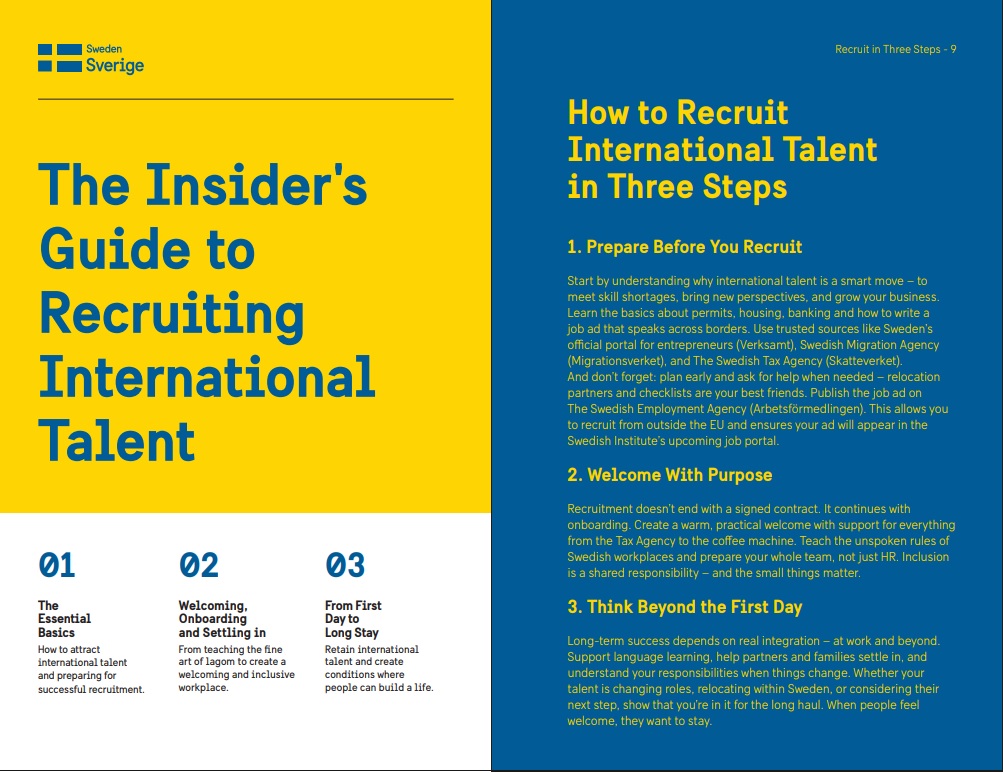
A new comprehensive handbook aimed at helping Swedish employers better recruit and retain international talent has recently been distributed to 1,000 businesses across Sweden. This initiative, part of a broader government campaign dubbed Work in Sweden, seeks to boost the country’s ability to attract and integrate skilled professionals from abroad.
The handbook is designed to provide employers with practical guidance on how to engage and support international workers, as well as how to create a more inclusive and diverse workforce. The project is led by Anna Broeders, the project manager behind the handbook, who emphasizes its practical, hands-on approach.
“We hope to not only encourage companies to recruit international talent but also give them the necessary tools and guidance to do so successfully,” says Broeders. “This is part of Sweden’s effort to position itself as an attractive destination for top global professionals.”
While the focus of the initiative is on international workers, some critics have pointed out that the handbook overlooks domestic issues related to underutilized talent within Sweden itself. Employment agencies in the country have limited resources and expertise when it comes to helping highly educated Swedish citizens—particularly those with foreign backgrounds—find employment. Recent reports have shown that while Sweden has a high level of education overall, more and more highly educated Swedes remain unemployed, with those from foreign backgrounds being disproportionately affected.
This gap has raised questions about how the government is managing its internal talent pool, particularly in the context of ongoing efforts to attract international professionals. While the Work in Sweden initiative addresses the need for external recruitment, the lack of focus on internal issues, such as the underemployment of skilled individuals already living in the country, remains a point of contention.
For now, though, the government’s attention is on attracting foreign expertise to fill crucial gaps in Sweden’s workforce, particularly in tech, healthcare, and engineering sectors, where there is a growing demand for skilled professionals.
Critics suggest that a more holistic approach, addressing both international recruitment and the underemployment of domestic talent, could better support Sweden’s long-term economic stability and growth.
As the Work in Sweden program moves forward, the question remains: will the government find a way to strike a balance between importing new talent and optimizing the potential of those already within Sweden’s borders?
The handbook marks a significant step in Sweden’s ambition to position itself as a leading destination for international talent, but it remains to be seen if the policy can address the full spectrum of talent management within the nation.