
In a clear and resolute message delivered during his visit to the World Economic Forum in Davos, Prime Minister Ulf Kristersson made it abundantly clear: Sweden will not bow to threats from the US, nor will it join President Donald Trump’s proposed peace council. As international leaders gathered to discuss global challenges, Kristersson’s remarks set the tone for Sweden’s commitment to standing firm on issues of sovereignty and diplomacy.
Strained US-Denmark Relations: The Focus of Kristersson’s Address
Sweden’s Prime Minister addressed a host of issues during his time in Davos, but the crux of his message focused on the deteriorating relationship between the United States and Denmark. Kristersson stressed that the most pressing issue at hand was the need to restore a constructive dialogue between the two nations.
“The most important thing right now is to restore a sensible tone of conversation between Denmark and the US and put an end to the threats. We cannot accept blackmail,” Kristersson stated emphatically. The backdrop to his comments was an escalating spat between the US and Denmark, after President Trump made controversial remarks regarding Greenland—a territory of Denmark—leading to diplomatic tensions.
Kristersson’s intervention is a reminder of Sweden’s diplomatic standing: committed to peaceful dialogue, yet fiercely protective of its own sovereignty and regional partnerships. He added that Sweden stands fully behind Denmark and Greenland in their disputes with the US, but stressed that Sweden was not inclined to escalate the situation into a full-scale trade war.
Sweden’s Defiant Stance on Trump’s Peace Council
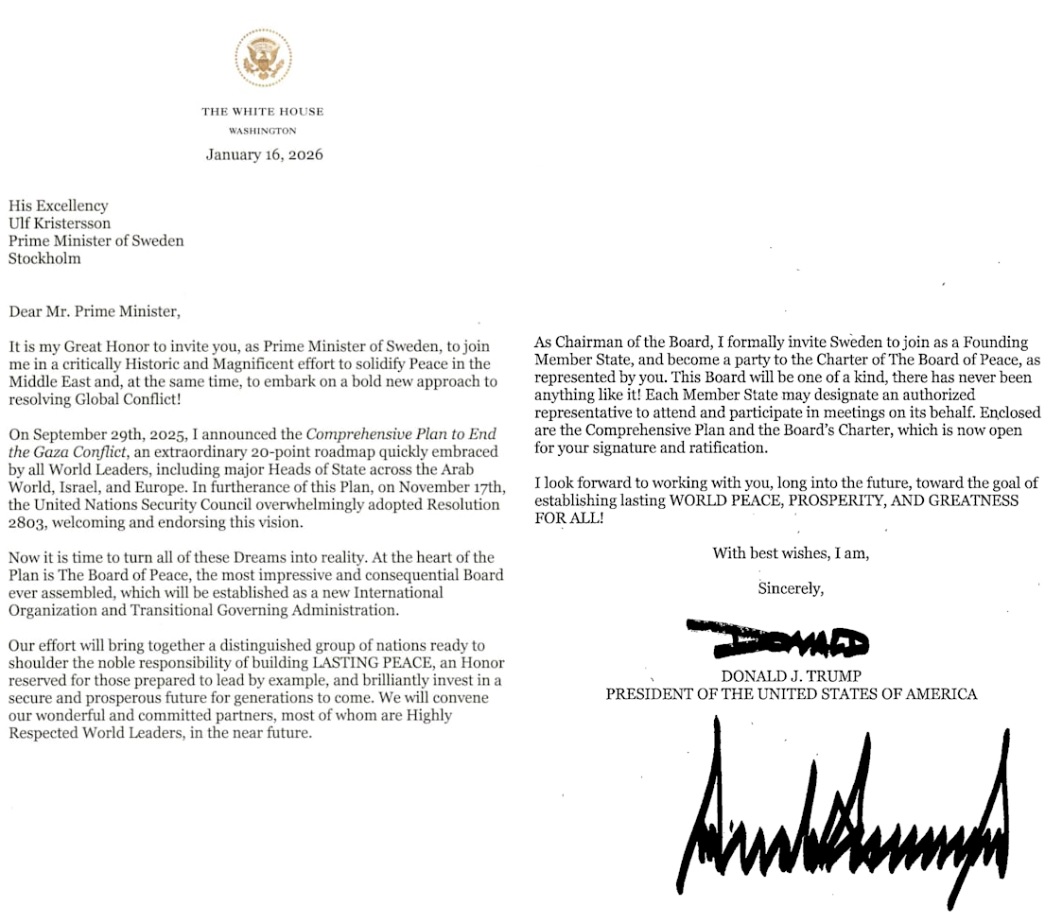
In a separate and equally significant declaration, Prime Minister Kristersson made it clear that Sweden would not be part of Donald Trump’s proposed peace council, a controversial initiative aimed at resolving global conflicts. “As the text stands right now, Sweden will not sign it,” Kristersson confirmed during a press conference. His statement came in direct response to an invitation from the Trump administration for countries to join a peace council, which many analysts saw as a vehicle for promoting US foreign policy interests.
This rejection was particularly notable as Israeli Prime Minister Benjamin Netanyahu had accepted the initiative earlier the same day, adding another layer of complexity to the issue. However, Sweden’s refusal to participate demonstrates a calculated positioning: while Sweden supports peace initiatives, it is unwilling to engage in initiatives perceived as politically biased or self-serving.
The EU’s Response: Avoiding Trade War but Prepared for Action
Sweden’s stance is not just about diplomacy; it is also a response to the larger geopolitical landscape, particularly the looming threat of a trade war between the EU and the US. While Kristersson made it clear that Sweden does not wish to initiate or escalate a trade war, he affirmed that Sweden, along with the EU, would not hesitate to retaliate should the US continue its aggressive economic actions.
“The EU has several tools at its disposal. I am not ruling anything out,” Kristersson remarked, signalling that Sweden and its EU counterparts are prepared for economic countermeasures if the US continues down a confrontational path. This is particularly relevant in the context of the so-called “trade bazooka”—the EU’s most powerful economic weapon—capable of imposing tariffs and sanctions on US goods in response to perceived unfair trade practices.
The conversation surrounding trade tensions is increasingly critical for Sweden, which, as one of Europe’s most export-oriented economies, relies heavily on stable international trade relations. Kristersson’s comments underscore Sweden’s strategic balancing act: advocating for open dialogue and cooperation, but maintaining a firm stance on issues of national and regional importance.
The Larger Picture: Sweden’s Role in Global Diplomacy
Sweden’s approach at Davos offers a clear message to the world: while Sweden is a committed partner in the global community, it will not tolerate external pressure or coercion. The Prime Minister’s remarks also highlight the growing role of the European Union in standing up to US policies, signalling that the EU is becoming more assertive in its defence of sovereignty and multilateralism.
In a world where populism, nationalism, and protectionism are on the rise, Sweden’s diplomacy reflects a commitment to principled leadership. With the EU increasingly positioning itself as a counterbalance to US unilateralism, Sweden’s alignment with Denmark, its steadfast opposition to Trump’s peace council, and its preparedness for economic retaliation underscore the nation’s dedication to promoting peace, stability, and multilateral cooperation.
What’s Next for Sweden and the EU?
As global tensions continue to shape international relations, Sweden will need to navigate the delicate balance of maintaining strong alliances while protecting its own national interests. The coming months will likely see further developments in the US-EU relationship, particularly with regard to trade and diplomatic engagement. Sweden’s next steps will be critical, and the way it handles its position within the EU will have long-term implications for its standing on the global stage.
Future Developments in Swedish Diplomacy – our editorial look
In our next article, we will explore the growing influence of the EU as a counterforce to global superpowers like the US and China. What role will Sweden play in shaping the future of European foreign policy? Stay connected with us as we continue to analyse these critical developments and what they mean for Sweden’s place in a rapidly evolving world.
For further updates, insights, and analysis, be sure to follow us on our social media channels and stay tuned for our next edition of the Nordic Business Journal.
Connect with Us:
Stay informed about Sweden’s evolving role in global politics by subscribing to Nordic Business Journal. Share your thoughts with us on Twitter and LinkedIn, and join the conversation with fellow thought leaders.