
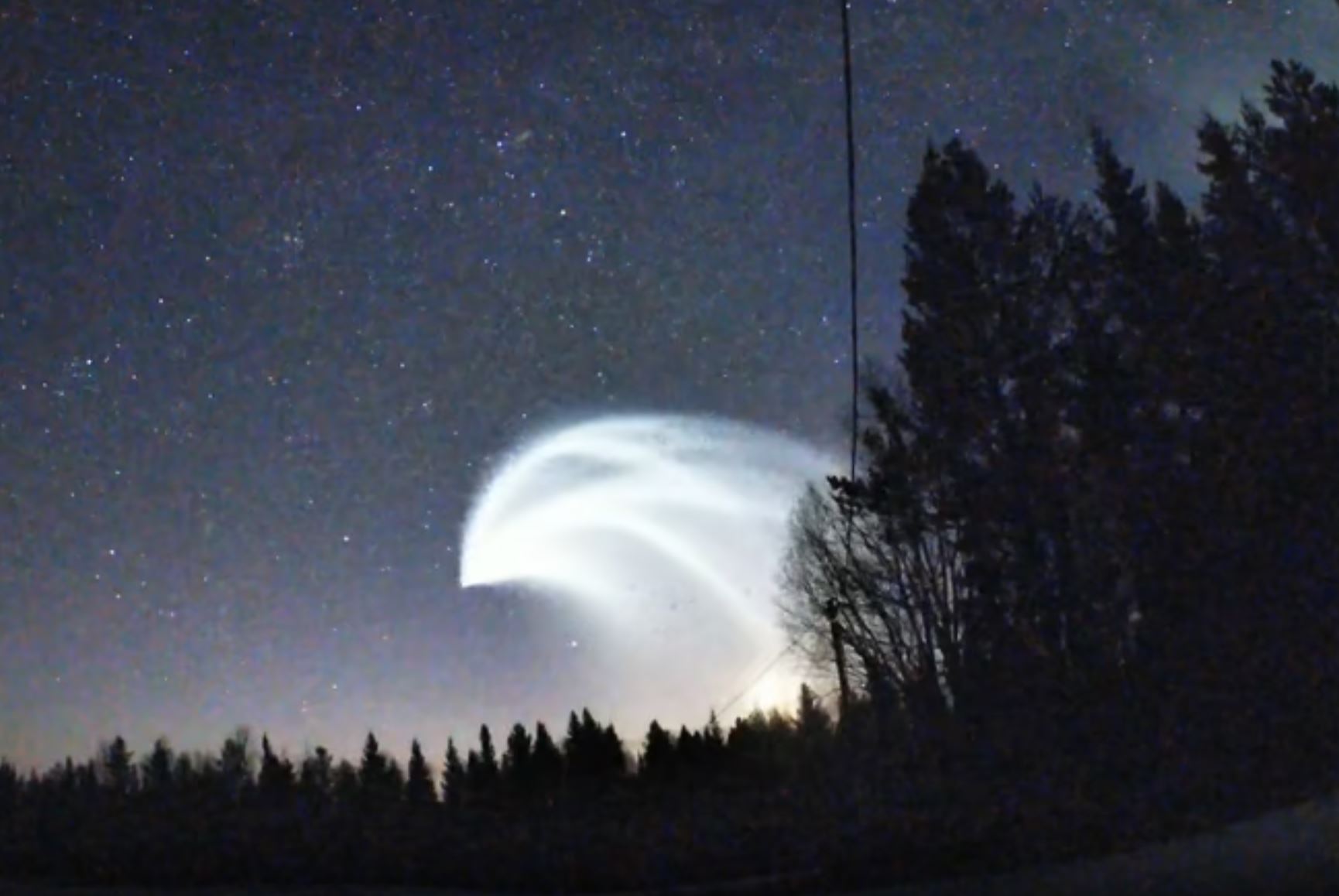
Last Friday night a striking light show over Västerbotten stopped drivers and night-shift workers across northern Sweden. Construction worker Veronica Sjöström in Umeå pulled her colleagues’ work van to the roadside to photograph an intense glow that she says “was almost like a car with high beams — very powerful and furious.” In Burträsk, Hugo Eriksson watched what he first thought was a comet before the spectacle contracted into a single bright orb that spun in the sky.
The explanation was prosaic: a Russian rocket launch from the Plesetsk Cosmodrome in northwestern Russia released gases high in the atmosphere that, when illuminated by sunlight during the night hours, created a spectacular luminous cloud. Eric Stempels, space researcher at Uppsala University, describes the effect succinctly: exhaust and other particulates in the upper atmosphere catch the sun and scatter light — a launch visible over a wide area at the right angle can look dramatic even hundreds of kilometres away.
Routine, visible and telling
Two immediate points matter for Nordic readers and businesses:
– This is largely a routine phenomenon. Military and civilian launch activity from Plesetsk and other northern launch sites routinely produces visible plumes when launches take place near local night-time hours. As Hans Liwång, professor of defence systems at the Swedish National Defence University, noted, periodic launches “don’t necessarily mean a new threat” — they are part of ongoing satellite replenishment and modernisation programs.
– Visibility does not equal hazard. The glowing clouds do not pose a direct physical danger to people on the ground. Aviation and maritime authorities coordinate with space-launch agencies to manage airspace and shipping during launches; what citizens see is an optical effect, not an airborne weapon.
But routine visibility masks several strategic and commercial considerations that matter for Nordic business and policy.
Strategic and market implications for the Nordics
1) Space is increasingly crowded, with business consequences
Launch cadence worldwide has increased markedly in recent years. More satellites (military and civilian), growing numbers of small-satellite constellations and more launch providers mean more objects in low Earth orbit (LEO). For companies dependent on satellite-delivered services — telecommunications, timing/GNSS, remote sensing, logistics tracking — greater traffic increases collision risk, potential service interruptions and future compliance and insurance complexity.
Practical takeaways:
– Corporates with critical reliance on satellite services should map single points of failure (e.g., single-operator telecommunication links) and plan redundant comms or terrestrial fallbacks.
– Procurement and insurance teams should factor in growing SSA (space situational awareness) premiums and contract clauses for resilience to satellite outages.
2) A business opportunity for Nordic spacetech and data firms
The Nordic region already has strengths in earth observation, optics, and advanced sensors. Greater demand for SSA services (tracking, debris modelling, collision-avoidance warnings) creates opportunities for Nordic SMEs, scaleups and research labs to commercialise software and sensors — and to offer trusted neutral data to international partners.
3) Civil-military overlap keeps risk-management on corporate agendas
Many satellites have dual-use capabilities. Even routine military launches can amplify geopolitical tensions or trigger renewed scrutiny of space traffic management. Nordic companies that operate internationally or that supply defence-adjacent tech should monitor export-control shifts and EU/NATO approaches to space governance to reduce compliance surprises.
4) Local economy and communications: tourism, panic prevention, and PR
Visible rocket plumes can be a tourism win (similar to aurora-chasing crowds) but also spark social media speculation that strains local emergency communication. Local governments and businesses can benefit by preparing rapid, factual communications for residents and tourists to avoid misinformation and to leverage curiosity (e.g., guided night-sky events, safe-viewing locations).
5) Environmental and regulatory externalities
High-altitude rocket exhaust interacts with the upper atmosphere, and some propellant types have longer-term effects on ozone and local atmospheric chemistry. While more research is needed, growing launch activity increases the urgency for greener propulsion technologies — an R&D area where Nordic engineering capacity can contribute.
What Nordic businesses and policymakers should do now
– Audit dependencies: identify which operations rely on satellites for comms, navigation or data; design redundancy plans.
– Engage with regulators and industry groups: support national SSA capabilities and policies that emphasize transparency and deconfliction.
– Watch insurance and procurement terms: expect rising attention to space-origin risks in supply chains and insurance pricing.
– Consider market moves: investors and entrepreneurs should evaluate opportunities in SSA services, rocket-propellant alternatives, optical sensors, and data analytics.
– Prepare communications playbooks: public-facing businesses in northern Sweden and neighbouring regions can craft rapid messaging templates for visible but harmless space events to reduce panic and exploit PR moments.
Concluding perspective
The luminous display over Västerbotten was a reminder that space activity is increasingly noticeable and relevant to everyday life in the Nordics. For the business community, routine military and commercial launches translate into both risk and opportunity — from resilience planning to new market niches in space monitoring and sustainable launch technologies. Being prepared, engaged and opportunistic will separate companies that merely react from those that profitably adapt.
Next steps and how to connect
Next in Nordic Business Journal: an in-depth analysis of space situational awareness in the Nordics — who is building regional SSA capacity, market opportunities for Nordic tech firms, and how businesses can purchase or subscribe to commercial SSA services. If you’d like us to pursue a specific angle — industry interview, regulatory brief, or a company profile — let us know.
Connect with us:
– Send suggestions or story tips to editorial@nordicbusinessjournal.com
– Subscribe for updates and newsletters at nordicbusinessjournal.com/subscribe
– Follow us on LinkedIn for alerts and expert commentary
We welcome reader questions and leads for experts or companies to feature in the follow-up piece.