Executive summary
The Swedish government has tabled an extra amending budget — a SEK 17.5 billion crisis package — to blunt the effects of rising global energy prices. Central to the plan is a temporary reduction of SEK 3 per litre on gasoline and diesel at the pump from July through November, alongside an additional SEK 1 billion for electricity subsidies. The package will be financed through new borrowing and requires parliamentary approval ahead of the Riksdag’s summer recess and likely clearance from the European Commission. For executives, investors and policymakers, the measures offer immediate support to households and energy‑intensive sectors but also raise questions about fiscal prudence, competitiveness, and consistency with Sweden’s climate objectives.
Why this matters now
A resurgence in Middle East tensions has pushed crude prices higher, adding to already elevated energy costs that are squeezing household budgets and raising input costs for Swedish firms. The government’s emergency budget is a political and economic response intended to preserve near‑term consumption and protect specific industries, but its temporary relief exposes trade‑offs that matter for investment decisions, corporate strategy and policy design across the Nordics and Europe.
What the package contains
Fuel tax cut: SEK 3 per litre reduction on gasoline and diesel at the pump, effective July–November. The government expects to seek EU approval for the measure.
Electricity support: SEK 1 billion in additional subsidies to shield consumers from volatile power prices.
Sector support to follow: Finance Minister Elisabeth Svantesson and Energy Minister Ebba Busch signalled further, targeted measures for agriculture, aviation and public transport in subsequent announcements.
Financing: The additional amending budget is unfunded in current accounts and will be financed by government borrowing.
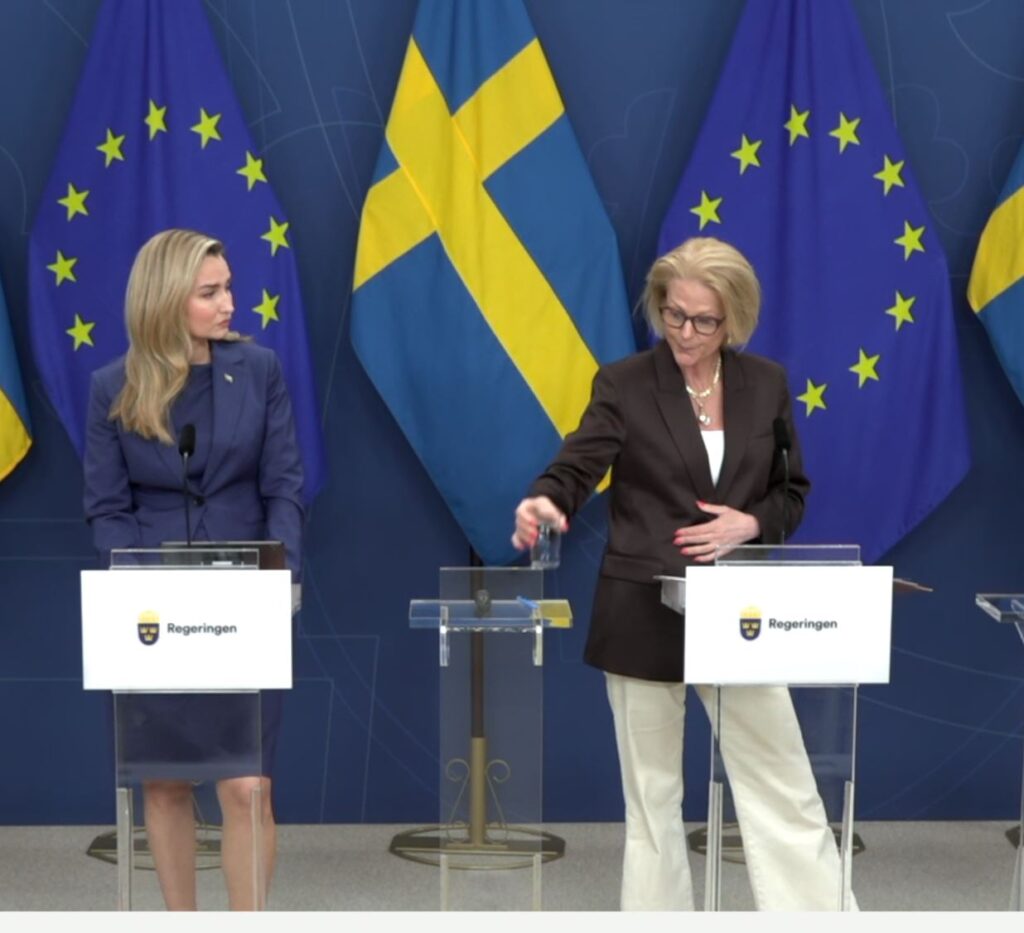
Energy Minister, Ebba Busch (KD) and Finance Minister Elisabeth Svantesson (M) at a press conference to announce government actions on the economy. Photo: SVT
Political and economic context
Sweden’s coalition framed the measures as defending households and hard‑hit industries. Energy Minister Ebba Busch (KD) stressed continuity — “we will stand on the side of households yesterday, today and tomorrow” — while Finance Minister Elisabeth Svantesson (M) indicated the package responds to downgrades in economic growth projections. The timing — ahead of the Riksdag’s summer recess — underscores the political urgency.
Strategic implications and trade‑offs
1. Short‑term relief vs. long‑term climate goals
A temporary excise tax cut delivers visible price relief quickly, but it weakens price signals that underpin Sweden’s decarbonisation strategy. Tax‑based incentives have been central to scaling electric vehicles and discouraging fossil fuel consumption. Repeated temporary reversals could slow structural shifts in mobility and logistics that businesses and investors rely on when planning green investments.
2. Distributional effects and competitiveness
Fuel tax cuts are blunt instruments: they tend to benefit drivers regardless of income and favour road‑heavy industries and longer commutes. Targeted measures — such as targeted rebates, means‑tested transfers, accelerated support for public transport and incentives for freight modal shift — typically provide better value for money and social equity. For exporters and energy‑intensive manufacturers, the package mitigates input‑cost pressure in the near term, but leaves uncertainty about medium‑term energy and carbon pricing.
3. Fiscal credibility and monetary policy interactions
Financing relief through net borrowing increases fiscal flexibility risks, albeit from a strong balance sheet by Nordic standards. Markets will watch whether temporary deficits persist and how they interact with the Riksbank’s inflation fight. The credibility of a plan that alternates between temporary relief and long‑term commitments to green investment will influence sovereign funding costs over time.
4. Regulatory and EU constraints
The government’s expectation of EU approval highlights legal and single‑market considerations. Brussels has tolerated emergency measures in previous crises but increasingly balances emergency relief with state‑aid rules and internal market integrity. The Commission’s response will set precedents for other EU states contemplating similar measures.
How businesses and investors should respond
Review scenario plans: Incorporate a temporary fuel‑price floor, a rebound to higher energy prices, and a policy path that restores green taxation.
Reassess transport and logistics strategies: Short‑term cost reductions may justify temporary operational adjustments, but long‑term investments (EV fleets, rail, energy‑efficiency measures) should continue given Sweden’s policy direction.
Monitor policy follow‑through: Details on targeted support for agriculture, aviation and public transport will determine sectoral revenue and cost trajectories.
Use the window for strategic investment: If liquidity and credit conditions permit, the period of lower fuel costs can be used to invest in decarbonisation infrastructure at lower operating cost risk.
Nordic and international perspective
Nordic peers have taken a range of approaches to energy shocks. Norway’s large fiscal buffers and sovereign wealth funds enable more direct household transfers and support for oil‑sector workers; Finland and Denmark have emphasised targeted social transfers and public‑transport upgrades. Across Europe, temporary duty reductions, targeted subsidies and direct transfers have been the dominant policy mix in recent energy shocks. Sweden’s package reflects a politically balanced, mixed approach: visible pump relief plus sectoral support, financed by borrowing.
Risks to watch
– Politicisation and policy drift: Repeated temporary tax freezes risk diluting Sweden’s long‑term climate policy credibility.
– Inflationary persistence: If relief fuels higher consumption without addressing supply constraints, inflation could remain elevated.
– Commission pushback or conditional approval: The EU may demand tighter targeting or sunset clauses.
– Fiscal slippage: Unfunded measures add to debt if not reversed or offset by future fiscal consolidation.
Why leaders and policymakers should care
The current measures are a pragmatic response to near‑term pain, but decision‑makers must balance short‑term political necessity with long‑term competitiveness and sustainability. For business leaders and investors, the episode is a reminder that macro‑policy remains a material driver of operating costs and strategic returns. For policymakers, the question is how to design relief that protects vulnerable households and strategic industries while preserving incentives for the green transition and maintaining fiscal resilience.
Conclusion — a strategic take
Sweden’s SEK 17.5 billion crisis package and SEK 3 per‑litre fuel cut provide rapid, politically salient relief as geopolitical shocks ripple through energy markets. Yet the effectiveness of those measures will be judged not only by their immediate impact on consumer wallets, but by how they are integrated into a credible, long‑term strategy that aligns fiscal policy with climate goals and economic competitiveness. Executives and investors should prepare for a hybrid policy environment: temporary relief with an eventual return to structural carbon pricing and green incentives. Policymakers have an opportunity to use short‑term support as a bridge, not a detour, toward resilient, low‑carbon growth.
What to watch next
– Parliamentary approval timing and any amendments from the Riksdag.
– The European Commission’s assessment and any conditionalities.
– Details and targeting of follow‑up measures for agriculture, aviation and public transport.
– Fiscal projections and whether the government outlines offsets or a medium‑term fiscal plan.
(Reporting based on government announcements; ministers quoted: Energy Minister Ebba Busch (KD) and Finance Minister Elisabeth Svantesson (M).)