Executive summary
Rising jet fuel costs tied to geopolitical tensions have increased airfares — yet Copenhagen Airport recorded its busiest May on record, handling 3.1 million passengers, up 7% year‑on‑year. Airports across Denmark, including Billund, Aarhus and Aalborg, report similar growth. The immediate lesson for executives, investors and policymakers is that demand resilience, pricing dynamics, and inventory timing can blunt the short‑term demand effects of higher fuel. But beneath the headline numbers lie structural challenges and strategic choices — from airline hedging and revenue management to sustainable aviation fuel (SAF) adoption and infrastructure capacity — that will determine whether this momentum is durable and aligned with Nordic climate commitments.
Passenger resilience despite a fuel shock
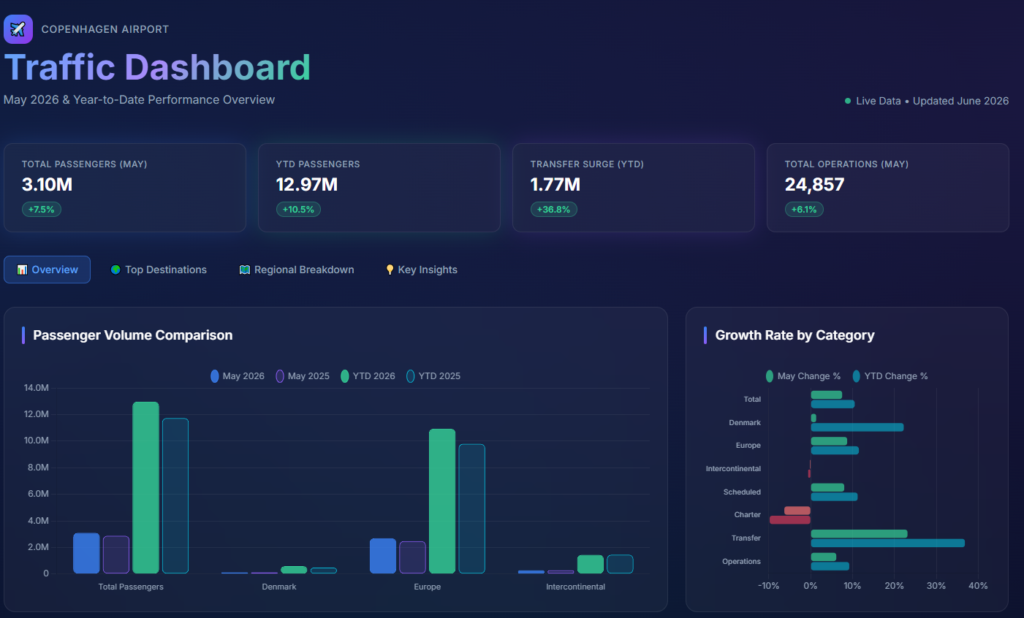
Copenhagen Airport’s May throughput of 3.1 million travellers — its best May on record — underlines a key feature of contemporary aviation markets: in the short term, passenger volumes can remain robust even as input costs rise. Copenhagen handled 32.4 million passengers last year and is targeting roughly 35.5 million this year; airport management is forecasting a record summer with more than 10 million travellers.
Industry observers attribute part of the apparent disconnect between rising jet fuel prices and passenger counts to timing and inventory. Many spring and summer travellers purchased tickets months in advance, locking in fares before recent fuel‑driven price increases were fully reflected. Danish Aviation’s head of secretariat, Mathias Milling, warns of a lagged impact: ticket yields will reflect fuel pressures only gradually. Copenhagen Airport’s commercial director Peter Krogsgaard says the airport is monitoring developments closely but, on current forecasts, does not expect a drop in passenger numbers.
Why demand is holding
Three market dynamics help explain sustained demand in Denmark and the broader Nordics:
Pre‑purchased tickets and booking lead times. Advance purchases blunt immediate demand responses to cost shocks.
Intact consumer spending power. Danish household balance sheets remain comparatively strong; economic psychology research (Aarhus University’s John Thøgersen) suggests consumers see discretionary travel as a high‑priority expenditure even amid price increases.
Competitive pricing and hedging. Airlines rarely translate 1:1 fuel cost increases into ticket prices. Competitive pressure, route economics and fuel hedges mute pass‑through to consumers in the near term, though this compresses airline margins.📊 Copenhagen Airport – Key Traffic Figures (May & YTD)
| Category | May 2026 | May 2025 | Change (%) | YTD 2026 | YTD 2025 | Change (%) |
|---|---|---|---|---|---|---|
| Total passengers | 3,099,829 | 2,883,686 | +7.5% | 12,965,241 | 11,736,594 | +10.5% |
| Denmark | 126,766 | 125,169 | +1.3% | 591,535 | 483,878 | +22.2% |
| Europe | 2,691,931 | 2,476,753 | +8.7% | 10,927,406 | 9,797,016 | +11.5% |
| Intercontinental | 281,132 | 281,764 | -0.2% | 1,446,300 | 1,455,700 | -0.6% |
| Scheduled flights | 3,011,914 | 2,789,827 | +8.0% | 12,576,004 | 11,304,931 | +11.2% |
| Charter etc. | 87,915 | 93,859 | -6.3% | 389,237 | 431,663 | -9.8% |
| Departures total | 1,541,948 | 1,438,206 | +7.2% | 6,403,023 | 5,807,482 | +10.3% |
| Local | 1,143,224 | 1,114,427 | +2.6% | 4,637,049 | 4,516,139 | +2.7% |
| Transfer/Transit | 398,724 | 323,779 | +23.1% | 1,765,974 | 1,291,343 | +36.8% |
| Total operations | 24,857 | 23,432 | +6.1% | 106,840 | 97,855 | +9.2% |
| Denmark | 1,903 | 1,923 | -1.0% | 8,587 | 8,098 | +6.0% |
| Europe | 21,552 | 20,100 | +7.2% | 91,404 | 82,911 | +10.2% |
| Intercontinental | 1,402 | 1,409 | -0.5% | 6,849 | 6,846 | 0.0% |
Europe includes Faroe Islands | Intercontinental includes Greenland. Source: Copenhagen Airport Report
The operational and commercial balancing act
Airlines and airports are confronting a two‑front challenge: managing margins today while preparing for regulatory and market shifts tomorrow.
Airline economics: Fuel volatility amplifies the value of effective hedging strategies, disciplined capacity management and ancillary revenue growth. Low‑cost carriers and network airlines will continue to diverge in their tactical responses: LCCs often protect market share via fare discipline; legacy carriers lean more on corporate demand and premium yields.
Airport finance and non‑aeronautical revenue: Higher passenger volumes boost retail, parking and F&B income, offsetting some fragility in aeronautical revenues. For Copenhagen, a strong summer would materially improve commercial returns, but it also increases pressure on terminal capacity and ground services.
Infrastructure and operations: A sustained rise in passengers demands investments in gates, security processing and surface access. For the Nordic region — where airport capacity constraints surfaced pre‑pandemic — operational bottlenecks could become a competitive constraint if growth persists without targeted investment.
Sustainability: a policy and cost inflection point
Two intersecting forces will shape aviation in the medium term: decarbonisation policy and SAF economics.
Policy frameworks: The EU Emissions Trading System already affects European aviation, and regulatory momentum toward tighter carbon pricing and higher SAF blending mandates (ReFuelEU and related initiatives) will raise operating costs for airlines unless offset by subsidies or innovation.
SAF supply and cost: SAF remains costlier and supply is limited. Airlines that can secure SAF supply contracts or scale domestic production will gain both regulatory and reputational advantage — but that requires capital, long‑term off‑take agreements and policy support.
Comparison with the neighbours:
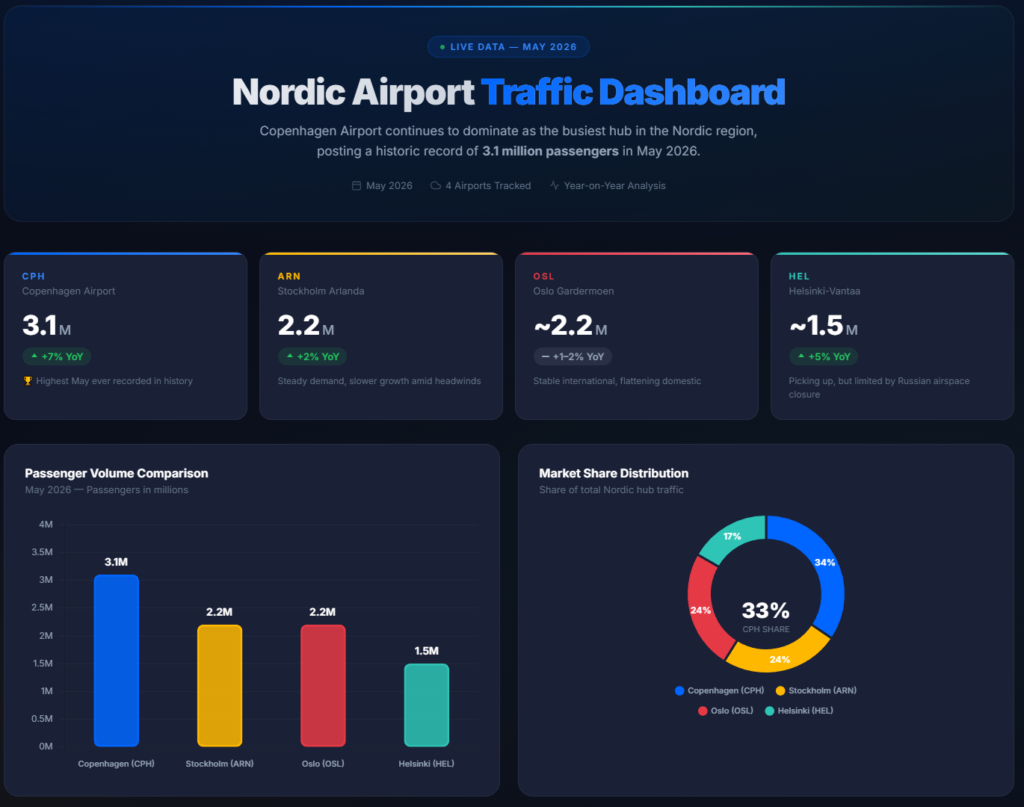
From the data below, Copenhagen Airport (CPH) remains the undisputed busiest aviation hub in the Nordic region, continuing to outperform its neighbours. In May 2026, CPH set a historic record with 3.1 million passengers, while other major Nordic airports saw steady but significantly lower traffic volumes. The latest figures highlight Copenhagen’s clear dominance.
The strategic implications for investors and policymakers
For decision‑makers, the current environment presents both opportunities and vulnerabilities:
For airports and investors: Strong passenger trends support near‑term revenue forecasts and private investment opportunities (terminals, retail concessions, ground transport). Yet investors should stress‑test assumptions about fuel prices, carbon regulation and gate capacity when modelling long‑term returns.
For airlines: Protect margins through active hedging, dynamic pricing and expanding ancillary revenue. Consider strategic partnerships or equity stakes in SAF projects to mitigate future cost inflation from mandates.
For policymakers: The apparent short‑term insensitivity of demand does not obviate climate goals. Policymakers must balance capacity and competitiveness with credible decarbonisation pathways — leveraging fiscal incentives for SAF, targeted airport infrastructure funding, and measures to ease modal shift on short haul where feasible.
Risks and early warning signals
Executives should monitor these indicators closely as potential inflection points:
– Lagged decline in bookings and yields once advance‑purchased tickets run down.
– Sharp, sustained crude oil or jet fuel price increases driven by supply shocks or an expanded geopolitical crisis.
– Acceleration of SAF mandates and carbon pricing without commensurate SAF availability or transitional support — squeezing airline margins.
– Operational disruptions (air traffic control strikes, infrastructure bottlenecks) that impair route economics and traveller experience.
Why this matters now
The current episode is a practical stress test of how resilient aviation demand is to input‑cost shocks in a high‑price environment. For the Nordics — a region with high connectivity, significant leisure travel and ambitious decarbonisation commitments — the way airlines, airports and governments respond determines not only profitability but also the pace and cost of the sector’s transition to lower emissions.
Conclusion: Manage today, invest for tomorrow
Copenhagen’s record May exposes a nuance often missed in headlines: passenger volumes can remain high even as cost pressures mount. That resilience buys time — but not indefinitely. Airline and airport leaders, investors and policymakers must move from defensive, short‑term responses toward strategic investments in capacity, fuel diversification and sustainability. Success will hinge on integrating commercial agility with long‑term decarbonisation policies that preserve connectivity while containing costs.
Editorial Outlook
Proposed follow‑up: “Financing the Decarbonisation of Nordic Air Travel” — a deep dive into how Nordic airlines, airports and governments are structuring investment, public‑private partnerships and offtake agreements to scale SAF production and airport greening. The piece would compare financing models, examine regulatory levers, and profile projects that could position the Nordics as a cost‑competitive, sustainable aviation hub.
Reader engagement
Nordic Business Journal welcomes responses, data tips and proposals for collaboration. If you are an executive, investor, policymaker or entrepreneur working on aviation strategy, infrastructure, SAF, or sustainable mobility in the Nordics, contact our editorial team to share insights or to propose contributions.
References
Copenhagen Airports A/S (2024) Traffic figures – May 2024. Copenhagen Airports A/S. Available at: https://www.cph.dk/en/corporate/press/news/traffic-figures-may-2024 (Accessed: 4 June 2026).
International Air Transport Association (IATA) (2024) Jet Fuel Price Monitor. IATA. Available at: https://www.iata.org/en/publications/economics/fuel-monitor/ (Accessed: 4 June 2026).
European Commission (2021) ReFuelEU Aviation: a proposal to boost sustainable aviation fuels in Europe. European Commission. Available at: https://transport.ec.europa.eu/transport-themes/sustainable/aviation/re-fuel-eu-aviation_en (Accessed: 4 June 2026).
International Energy Agency (IEA) (2022) Sustainable Aviation Fuels: Market Status and Outlook. IEA. Available at: https://www.iea.org/reports/sustainable-aviation-fuels (Accessed: 4 June 2026).
EUROCONTROL (2024) European Aviation — Traffic, Capacity and Recovery Monitor. EUROCONTROL. Available at: https://www.eurocontrol.int/publication/air-traffic-forecast-and-recovery-monitor (Accessed: 4 June 2026).