Executive Introduction
For the first time on record, residents of Stockholm County hold the distinction of longest life expectancy in Sweden—a milestone that speaks to the capital’s concentration of economic opportunity, healthcare infrastructure, and lifestyle advantages. Yet this statistical triumph arrives at a moment of mounting tension within the Swedish welfare model. Even as Stockholmers extend their lifespans, the country confronts a parallel public health crisis of a different order: the accelerating prevalence of obesity, now affecting an estimated 1.3 million adults nationwide and straining a healthcare system already struggling to deliver adequate treatment.
The juxtaposition is instructive. Sweden’s regional health disparities—between prosperous, densely populated urban centres and ageing, depopulating northern counties—are widening. Meanwhile, a preventable chronic condition that drives excess mortality and cascading comorbidities is outpacing the state’s capacity to respond. For policymakers, investors in life sciences, and healthcare strategists across the Nordic region, the challenge is not merely clinical. It is structural, economic, and increasingly geopolitical in a world where workforce health directly shapes national competitiveness.
The Stockholm Advantage: Geography, Wealth, and the Longevity Premium
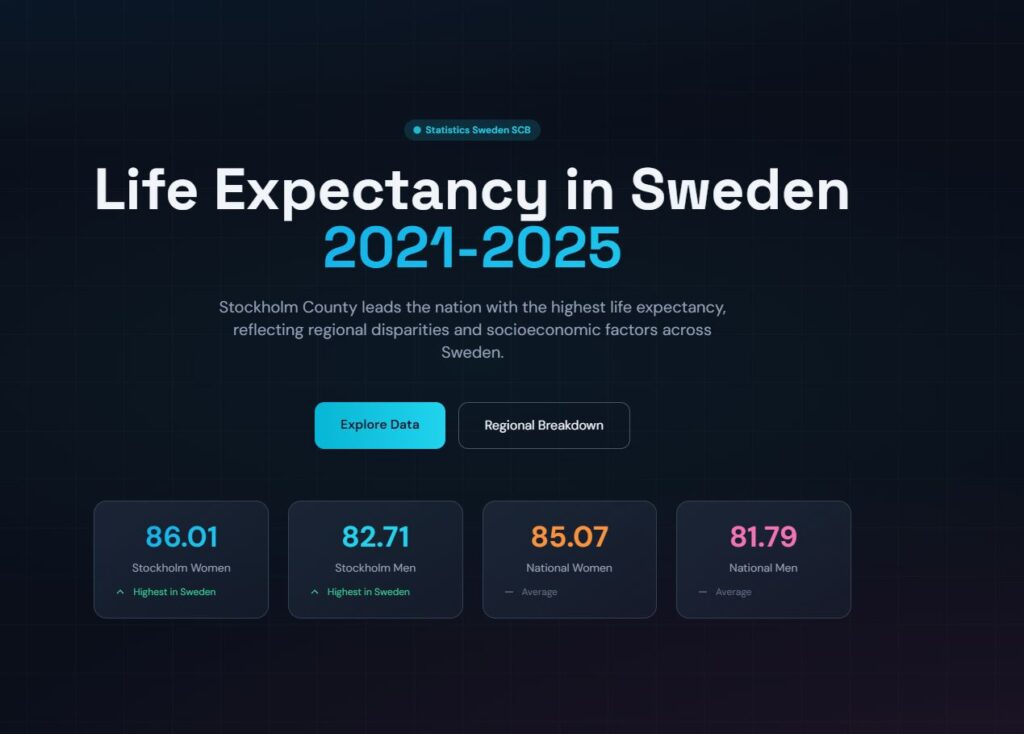
Statistics Sweden’s latest figures confirm what demographers have long anticipated: Stockholm has overtaken Halland, the southwestern county that previously led national life expectancy rankings. Uppsala, Jönköping, and Halland remain close behind, forming a contiguous belt of above-average longevity that stretches from the Lake Mälaren region to the Kattegat coast.
The pattern is neither coincidental nor uniquely Swedish. Across the Nordic countries, capital regions and university cities consistently outperform national averages. Copenhagen, Oslo, and Helsinki exhibit similar premiums. The drivers are well understood: higher educational attainment, greater employment in knowledge-intensive sectors, superior access to specialist healthcare, lower smoking prevalence, and higher levels of physical activity associated with urban infrastructure and disposable income.
Stockholm’s ascent also reflects a demographic dividend. The county’s population is younger than the national average, bolstered by sustained inward migration of working-age professionals from across Sweden and abroad. This inflow—critical to the region’s tech and finance sectors—skews mortality statistics favourably while simultaneously masking underlying pressures on housing, primary care, and social services.
For business leaders, the implication is clear. Stockholm’s labour pool is not only skilled but, by Nordic standards, durable. The region offers a comparative advantage in industries where talent retention and productivity over extended careers matter: pharmaceuticals, medical technology, asset management, and software engineering. Yet this advantage is contingent upon continued investment in the determinants of health—transport, green space, air quality, and preventive care—that underpin the longevity premium.

The Northern Divide: Structural Disadvantage and Demographic Decline
At the opposite pole of Sweden’s health geography lie Norrbotten, Västernorrland, and Gävleborg—counties where life expectancy lags significantly. These regions share common characteristics: ageing populations, outmigration of younger cohorts, industrial restructuring away from mining and forestry, and the logistical challenges of delivering healthcare across vast, sparsely settled territories.
The disparity carries economic weight. Northern Sweden’s resource base—iron ore, timber, hydropower, and increasingly, data centres and green hydrogen projects—remains integral to national export performance and the European energy transition. Yet the human infrastructure supporting these industries is eroding. Employers in Kiruna, Skellefteå, and Sundsvall face intensifying recruitment challenges, not solely due to skills shortages but because prospective workers weigh quality-of-life factors, including healthcare accessibility and life expectancy, in their locational decisions.
The Nordic model has historically mitigated such regional imbalances through redistribution and universal service guarantees. Whether that model can sustain its equity commitment amid fiscal pressures, defence modernisation demands, and the capital region’s gravitational pull-on talent is an open question. For investors in northern Sweden’s industrial renaissance—Northvolt’s battery ecosystem, H2 Green Steel’s hydrogen ventures, and expanding mining operations—the health gap represents a material risk to workforce planning and operational continuity.
The Obesity Paradox: A Preventable Crisis in a Preventive System
If Stockholm’s longevity leadership illustrates the Nordic welfare state’s strengths, Sweden’s obesity trajectory exposes its limitations. The Swedish National Board of Health and Welfare (Socialstyrelsen) reports that diagnosis rates are rising, yet healthcare reach remains inadequate despite the availability of effective interventions. The gap between epidemiological reality and clinical response is widening.
This is not a failure of medical science. Pharmacological treatments, including GLP-1 receptor agonists, have demonstrated transformative efficacy. Bariatric surgery programmes, where accessible, yield sustained outcomes. The deficit is systemic: primary care capacity constraints, reimbursement complexities, fragmented pathways between diagnosis and treatment, and lingering stigma that discourages patient presentation.
The economic calculus is stark. Obesity drives excess mortality, yes, but also cardiovascular disease, type 2 diabetes, certain cancers, musculoskeletal disorders, and depression—conditions that compound healthcare expenditure and reduce labour force participation. With 1.3 million adults affected in a population of 10.5 million, the condition touches roughly one in eight working-age Swedes. The productivity implications, measured in absenteeism, presenteeism, and early exit from employment, are substantial.
For the Nordic region, the obesity challenge carries competitive dimensions. Neighbouring Denmark, through Novo Nordisk, has emerged as the global epicentre of anti-obesity pharmaceutical innovation—a development that has reshaped the Danish economy and Copenhagen’s equity markets. Sweden possesses comparable research strengths in life sciences, concentrated in Stockholm, Uppsala, and Medicon Valley’s Swedish segment. Yet the domestic market’s failure to deploy existing treatments at scale suggests a disconnect between innovation capacity and healthcare system absorption—a pattern that should concern both policymakers and investors in Swedish health tech.
Strategic Implications: Health as Economic Infrastructure
Three interconnected developments merit attention from senior decision-makers.
First, the fiscal sustainability of Sweden’s healthcare model is approaching an inflection point. An ageing population, rising chronic disease burden, and the cost of novel therapeutics are converging. The obesity treatment gap is symptomatic of a broader tension: the system excels at acute intervention but struggles with longitudinal, multidisciplinary management of complex conditions. Digital health platforms, value-based care contracts, and public-private partnerships in service delivery are likely to feature prominently in forthcoming reform discussions.
Second, regional health disparities are becoming a competitiveness issue, not merely an equity concern. As remote work normalises and corporate location decisions grow more fluid, the quality of local healthcare infrastructure influences talent attraction. Municipalities and regional authorities that invest in preventive services, digital health access, and lifestyle-oriented urban planning may secure disproportionate economic returns.
Third, the intersection of sustainability and health policy is deepening. The Nordic countries’ leadership in environmental standards is uncontested; less examined is how climate adaptation, food systems reform, and urban design influence population health outcomes. Stockholm’s longevity advantage partly reflects walkable neighbourhoods, accessible archipelago recreation, and progressive tobacco and alcohol policies. Extending these environmental health benefits—while addressing the obesogenic features of modern consumer economies—represents a frontier for integrated policy design.
Conclusion: Beyond the Statistics
Stockholm’s emergence as Sweden’s longevity leader is a genuine achievement, reflecting decades of investment in education, infrastructure, and public health. Yet it is also a reminder that Nordic prosperity is not evenly distributed, geographically or physiologically. The simultaneous rise of obesity as a national health priority underscores a difficult truth: even in societies with exceptional institutional capacity, lifestyle diseases can outpace institutional response.
For internationally minded business leaders, the lesson is pragmatic. Sweden remains an attractive operating environment—stable, innovative, and comparatively healthy. But the trends beneath the headline figures demand scrutiny. Workforce health is transitioning from a human resources concern to a strategic risk and, potentially, a source of competitive differentiation. Companies and investors that anticipate regulatory shifts toward preventive care, digital health integration, and regional equity will be better positioned than those that treat health statistics as background noise.
The Nordic model is not broken, but it is being tested. How Sweden reconciles Stockholm’s success with Norrbotten’s challenges, and how it closes the gap between obesity diagnosis and treatment, will shape the region’s economic trajectory for the coming decade.
Editorial Outlook
A follow-up article should examine the emerging Nordic pharmaceutical and digital health ecosystem’s capacity to address chronic disease at scale—with particular attention to Sweden’s positioning relative to Denmark’s Novo Nordisk-led obesity therapeutics dominance. This analysis would assess whether Swedish innovation policy, healthcare procurement, and regulatory frameworks are aligned to capture economic value from domestic health challenges, or whether structural fragmentation will see clinical demand met primarily by imported solutions. An additional angle: the implications of EU pharmaceutical strategy and joint procurement initiatives for national healthcare autonomy and Nordic life sciences competitiveness.
Sources: Eurostat data, Statistics Sweden’s demographic databases, OECD,
Engage with Nordic Business Journal
Nordic Business Journal delivers strategic intelligence and analytical depth for senior executives, investors, policymakers, and entrepreneurs navigating the Nordic and international business landscape. For further insights, partnership inquiries, or to discuss the themes raised in this article, we welcome your engagement.
Connect with us:
Editorial and subscriptions: editorial@nordicbusinessjournal.com
Partnerships and events: Coming up soon
Follow Nordic Business Journal for continuing coverage of Nordic competitiveness, innovation policy, and the forces shaping the region’s economic future.