
In the frozen north of Sweden, a church is about to do something churches are not supposed to do. It’s going to move.
On Tuesday morning, the great wooden church of Kiruna—672 tons of timber, copper, and history—will begin a five-kilometre journey to its new home. Engineers call it a relocation. To the people of Kiruna, it feels more like a pilgrimage.
This plan has been eight years in the making. The first feasibility studies began in 2017, when it became clear that the ground beneath the town was shifting, destabilized by decades of iron ore mining. Dismantling the church brick by brick was an option, but in the end the decision was made to move it whole. Riskier. Costlier. More dramatic. But also, more faithful to the spirit of the building.
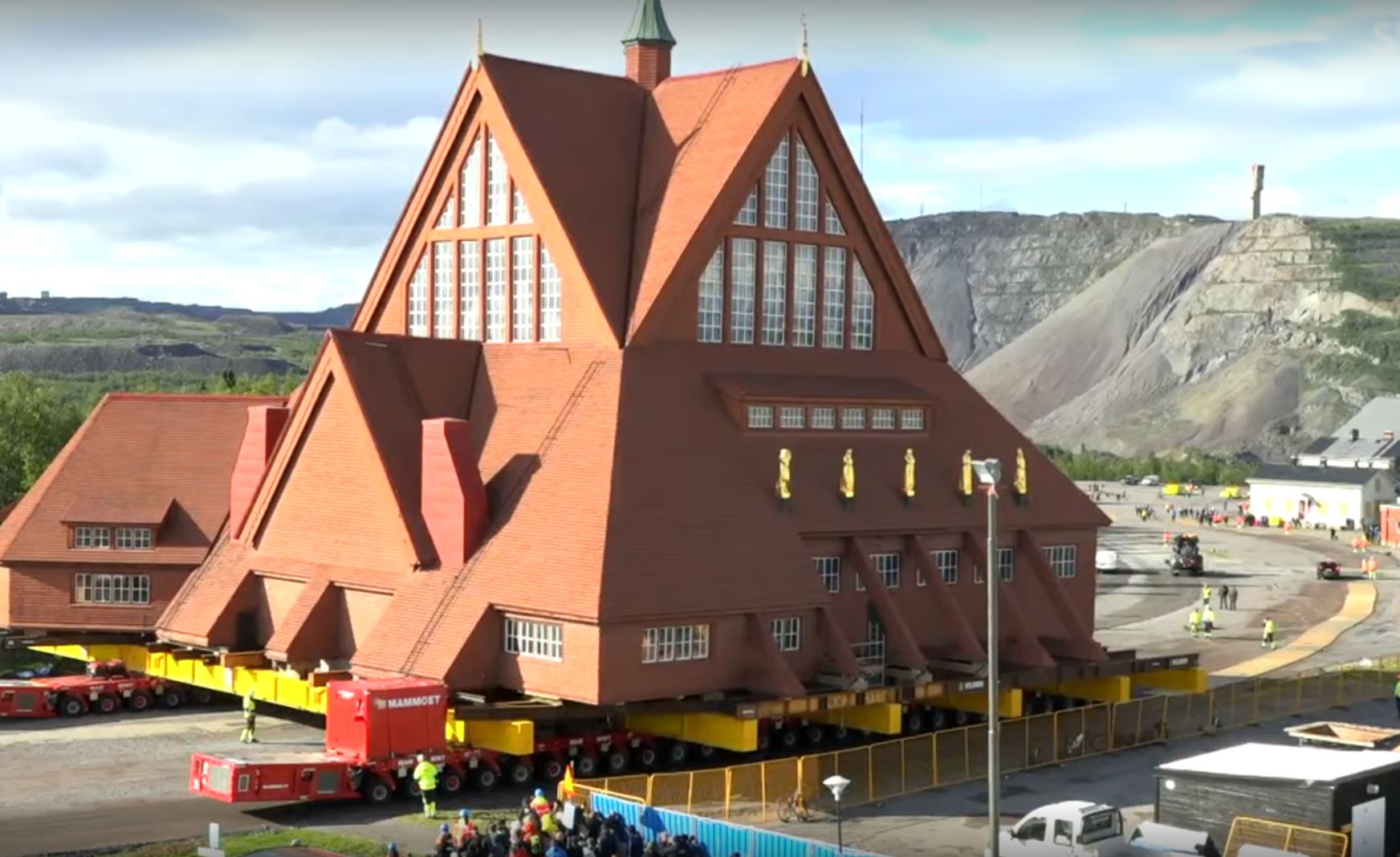
For months, the work has looked more like an archaeological dig than a construction site. Beneath the church, engineers carved away 3,200 cubic meters of soil and gravel, sliding custom steel beams into place to hold the structure steady. Inside, workers lifted out pews and fixtures, while leaving treasures like Prince Eugene’s painted altarpiece and the massive 2,858-pipe organ behind, carefully shielded from harm.
The road ahead has been widened to three times its size. It will take the church hours to crawl those five kilometres, inch by inch, on a convoy of colossal trailers. To watch it will be to see gravity itself challenged.
LKAB, the mining company overseeing the town’s relocation, refuses to reveal the cost. “The value lies in the cultural building we are moving,” says project manager Stefan Holmblad Johansson. What can be said is that this is the largest single project in the entire urban move—a process that is slowly shifting Kiruna piece by piece to safer ground.
Already, the move has drawn international attention. Seventy-five journalists and photographers from 38 outlets are in town, cameras ready as the church begins to roll. Gabriella Bennett of The Times says she sees the event as more than an engineering feat. “I want to talk to people who are affected by the urban relocation,” she explains. “I’m interested in how you preserve the soul of a city in a process like this.”
And that may be the real story. Not just the spectacle of a 672-ton church rolling down the road, but the question of what it means for a community to uproot itself and carry its history forward. On Tuesday morning, as steel and hydraulics strain under the weight, Kiruna’s church will set off on its strange procession—a building on wheels, watched by the world, carrying with it the heart of a town.