
Updated 11:51 | Published 11:33
John Clarke, Michel H. Devoret, and John M. Martinis have been awarded the 2025 Nobel Prize in Physics for groundbreaking research in quantum physics.
The announcement came today from the Royal Swedish Academy of Sciences, which follows Alfred Nobel’s original vision—to honour those who make the most significant discovery or invention in physics.
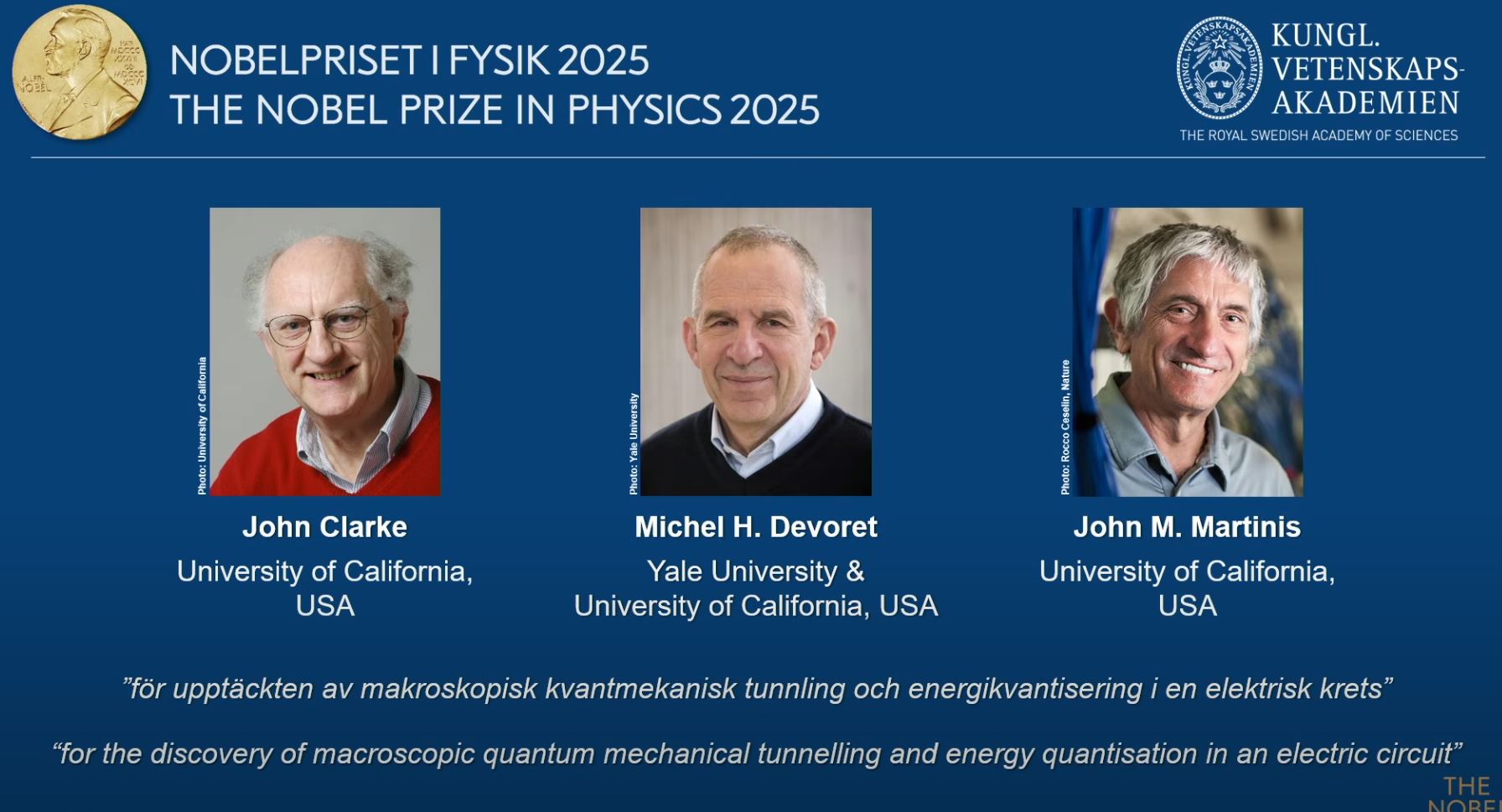
About the winners
John Clarke
- Clarke is a British-American physicist, professor emeritus at UC Berkeley.
- He studied at Cambridge, earning his BA, MA, and PhD in physics in the 1960s.
- His main contributions are in superconductivity and superconducting electronics. In particular:
• He developed and refined SQUIDs (Superconducting Quantum Interference Devices), which are extremely sensitive detectors of magnetic flux.
• He’s also worked on noise sources (like “1/f noise”), non-equilibrium superconductivity, and pushing measurement sensitivity close to quantum limits. - His work has practical uses (magnetometry, imaging, etc.) and fundamental ones (probing quantum behaviour of macroscopic systems).
Michel H. Devoret
- Devoret is a French physicist, professor at Yale, known for experimental work in quantum condensed matter.
- He started his education in France (telecommunications engineering, quantum optics, atomic/molecular physics) and got his PhD in condensed matter physics.
- Early in his career, he worked as a postdoc in John Clarke’s lab (Berkeley) and measured for the first time mesoscopic quantum levels in a Josephson junction.
- He helped found the “Quantronics” group in France (CEA-Saclay), with Daniel Estève and Cristian Urbina. Key achievements: invention of the single-electron pump, observation of the charge carried by Cooper pairs, development of a superconducting artificial atom (“Quantronium”).
- At Yale since 2002, his work has focused on superconducting circuits (Josephson junctions), developing low-noise amplifiers, qubit technologies, circuit QED (where quantum optics meets circuits), and quantum information processing.
John M. Martinis
- Martinis is an American physicist, emeritus professor at UCSB (University of California Santa Barbara), and active in the quantum computing industry.
- He did his BS and PhD at UC Berkeley; his PhD work involved demonstrating quantum behaviour in a Josephson tunnel junction (macroscopic quantum tunneling, energy-level quantization) under a current-bias.
- After that came postdoctoral work (France, then NIST in the U.S.), working on low-temperature device physics, superconducting devices, measurement techniques.
- From the 2000s onward, he’s been one of the central figures in superconducting qubits and quantum computers. At UCSB he built up research on qubit coherence, circuit design, scaling. He later joined Google’s Quantum AI efforts, leading to experiments like “quantum supremacy” in 2019: showing that a quantum processor could outperform classical computers for certain specific tasks.
Why their joint work gets the Nobel
To connect the dots: all three have made key contributions to making quantum mechanics not just a theory about atoms, but something you can build circuits with—devices where phenomena like tunnelling and energy quantization aren’t just theoretical curiosities but directly observable, controllable, and usable. Their work laid groundwork for quantum technologies (qubits, quantum amplifiers, etc.) by showing how “macroscopic” circuits can display genuinely quantum behaviour.
Details about their work later.