
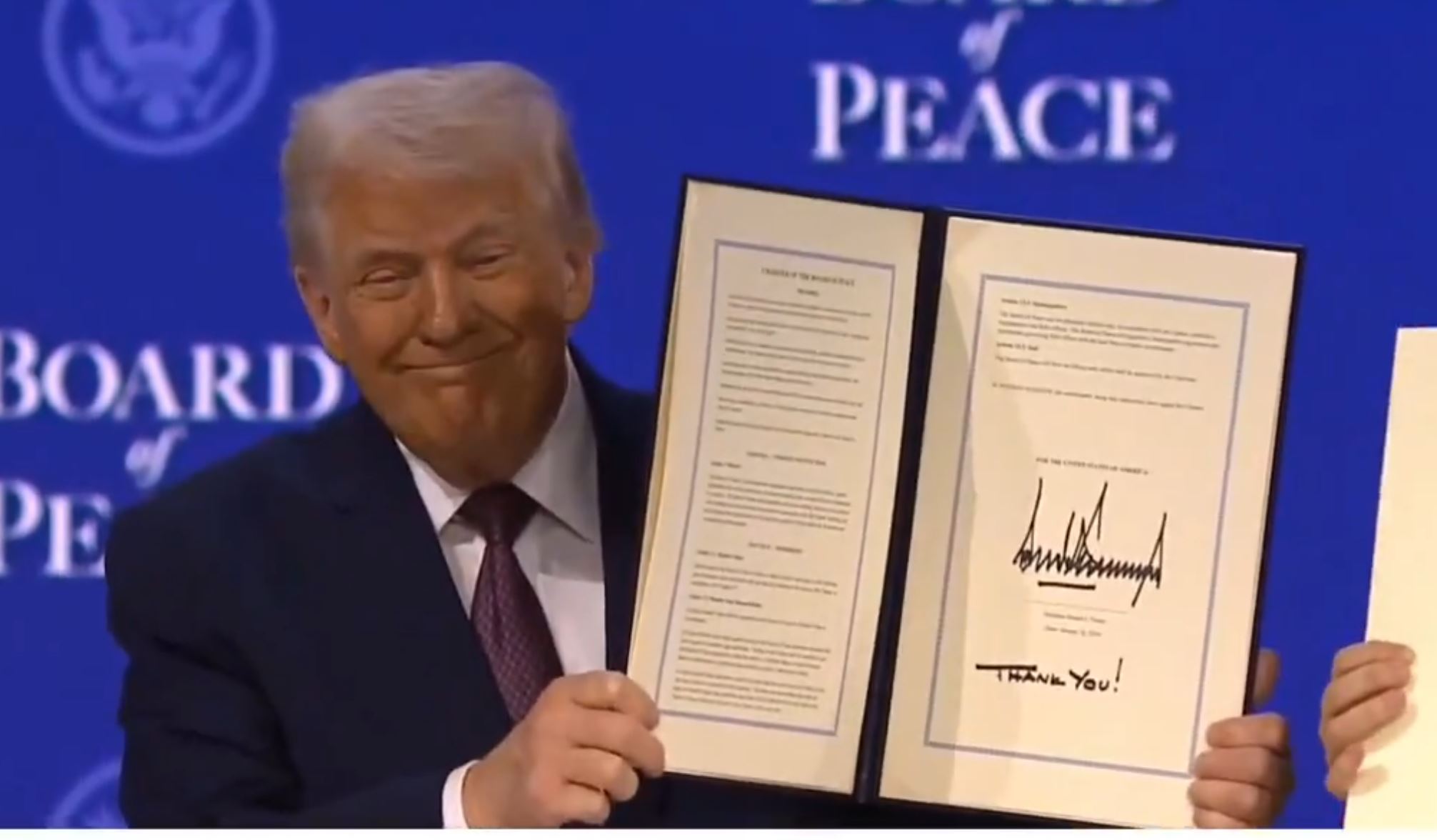
In an ambitious and controversial move, U.S. President Donald Trump has formally launched an international peace council that promises to reshape global diplomacy. In what could be a game-changer for the future of conflict resolution, Trump unveiled the council in Davos last Thursday, signing its foundational statutes at a high-profile ceremony. The initiative, designed to bring together over 60 countries and backed by the Vatican, marks a significant step in Trump’s post-presidency political endeavours and ambitions to redefine global peacekeeping.
The Council’s Global Reach and Initial Reactions
The peace council, though still in its nascent stages, aims to involve countries from across the globe, with some notable figures already signing on. Representatives from 19 countries—including Bahrain, Morocco, Argentina, Turkey, Saudi Arabia, and several Central Asian nations—joined Trump in Davos to officially sign the charter. To date, the White House reports that 30 countries have accepted the invitation, with Israel, Egypt, Vietnam, and Belarus among the newest additions to the fold.
However, not all of the world’s major players are on board. Leading powers such as Russia, China, Germany, and the United Kingdom have expressed reservations about the council’s structure and mandate, preferring to study the proposal in greater detail before committing. However, some reports hold that Russian has agreed to join. Meanwhile, some countries, like Sweden, Norway, and France, have voiced outright opposition, citing concerns about the council’s broad and undefined mandate. Swedish Prime Minister Ulf Kristersson has stated that under the current terms, Sweden will not sign the agreement, emphasising the need for further clarity.
1. Financial barrier – where member countries must make a substantial financial contribution to become permanent members of the council – amount in somewhere around $1 billion.
2. Alternative platform: where it is believed that Trump is trying to create an alternative to the United Nations. Therefore, he creates a structure managed by him where he will have decisive power.
3. Veto power: The chairman of the council (Trump) will have the right to block any decision.
The Controversial Mandate: From Gaza to Global Peacebuilding
Initially, the UN Security Council’s endorsement of the peace council last November focused on a mandate limited to the Gaza Strip, with a timeline running through 2027. However, the final statutes signed in Davos appear to expand the council’s role significantly, granting it a more general scope for global peacebuilding. The council’s statutes now include the ambitious goal of addressing conflicts worldwide in accordance with international law, which raises questions about its ability to influence and intervene in diverse geopolitical crises.
At the heart of the peace council’s mission is the task of demilitarising and rebuilding Gaza—a project Trump has championed as crucial for long-term stability in the Middle East. But Trump’s vision for the council goes far beyond Gaza. In his speech at Davos, he boldly declared, “Once this council is established, we can do basically anything—in consultation with the UN.” This statement has raised eyebrows among critics and supporters alike, sparking debate over whether the council will become an effective peace broker or an overreaching diplomatic tool.
Leadership and Governance: Trump’s Central Role
One of the most striking features of the peace council is the unprecedented power that Trump himself holds as chairman. As stipulated in the statutes, Trump will wield veto power over decisions and the authority to expel member nations if necessary. This concentration of power has fuelled concerns about the council’s potential to become a vehicle for Trump’s personal agenda rather than a truly multilateral platform for peace.
While Trump has expressed confidence that the council will be successful in Gaza, his broader vision for the council remains unclear. Trump’s emphasis on the council’s flexibility to address various global conflicts has left many wondering how it will interact with existing international organisations, particularly the United Nations. The council’s potential to act as an alternative or complement to UN peacekeeping efforts raises critical questions about its role in the existing global governance structure.
Strategic Implications and Challenges Ahead
The peace council’s formalisation at the World Economic Forum in Davos reflects the growing desire for new, innovative approaches to international diplomacy. However, the council’s mixed reception underscores the challenges it faces in garnering widespread support. While the U.S. and several Middle Eastern and Central Asian countries have signed on, many key European and Asian powers remain sceptical. For the council to achieve its ambitious goals, it will need to establish a clear framework for cooperation with the UN and other international bodies, ensuring that its actions complement rather than undermine existing peace initiatives.
Moreover, the council’s success will depend on its ability to navigate complex geopolitical dynamics. As some nations have pointed out, having Russia and Ukraine sit on the same peace council could prove problematic, given the ongoing conflict in Eastern Europe. Similarly, the inclusion of countries with divergent political interests—such as Israel and Iran—could complicate efforts to address regional and global conflicts effectively.
A Fork in the Road: What’s Next?
As the peace council continues to take shape, questions remain about its long-term viability and influence on global peacebuilding efforts. Will it become a major force for resolving conflict, or will it falter due to political infighting and a lack of clear objectives? The coming months will be critical in determining whether the peace council can deliver on its promises or if it will fade into irrelevance, like many ambitious diplomatic initiatives before it.
Moving Forward: Connect with Us
For the next edition, we will explore the evolving landscape of international diplomacy and how the rise of new geopolitical players—such as China, India, and the Middle Eastern states—could reshape the future of global conflict resolution. Stay connected with Nordic Business Journal for further insights into this groundbreaking initiative and other key developments in global politics.
We invite our readers to join the conversation and share their thoughts with us. Your feedback is invaluable as we continue to cover the most pressing issues of our time.
Follow Us:
Stay engaged with Nordic Business Journal through our digital platforms and share your views on the Trump Peace Council and other global diplomatic matters.