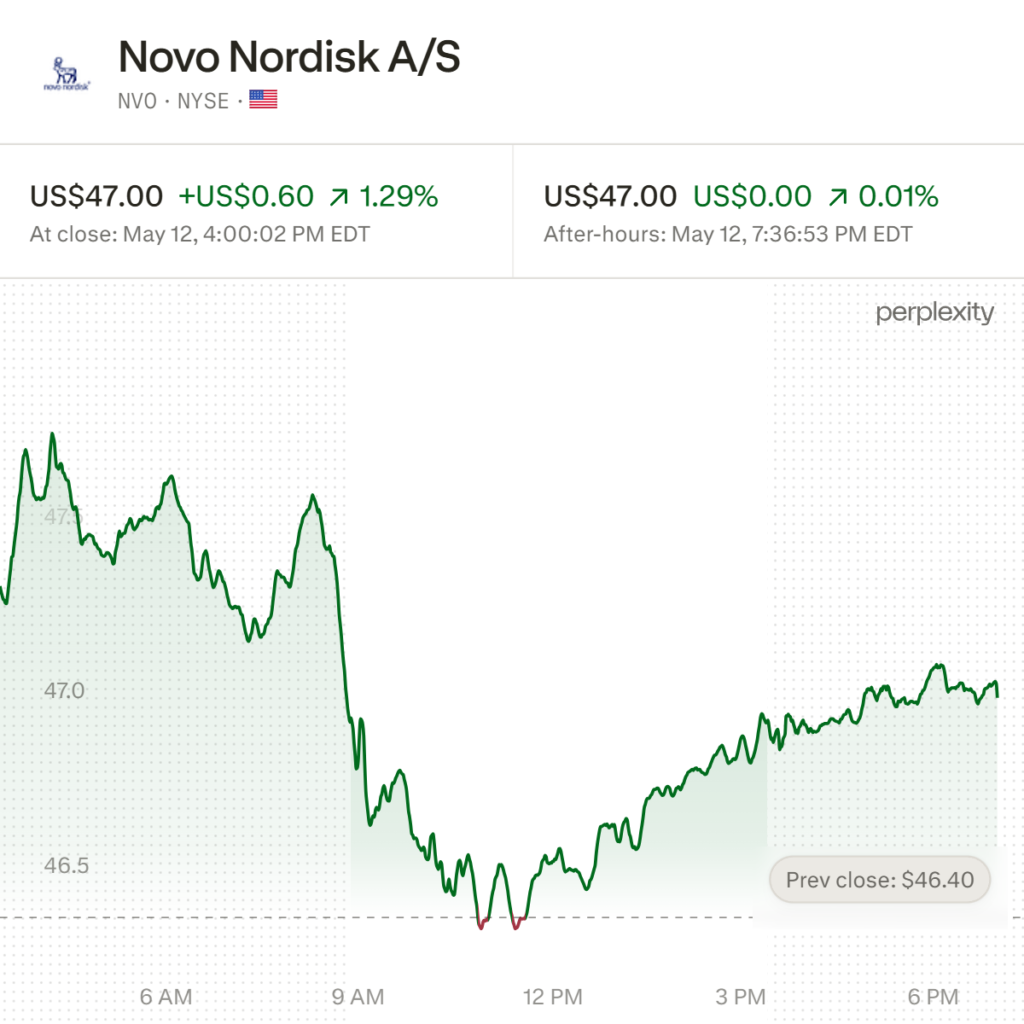
Novo Nordisk’s share price has rebounded since the sharp sell-off in March, driven by a steady recovery in sales, improved investor sentiment and signs that management is stabilising growth. Yet the company faces a recalibrated competitive landscape, evolving payer scrutiny and operational challenges that make a full and rapid return to its 2023–24 market highs unlikely. For senior executives, investors and policymakers, the question is no longer whether Novo can grow — it is how the company converts its GLP‑1 leadership into durable, diversified value in a market moving from boom to maturation.
The rest of this article:
- situates the recent share movement in macro and sector context,
- analyses the competitive and regulatory forces reshaping Novo’s prospects,
- outlines strategic levers and risks for the company and market participants, and
- offers a forward-looking view for decision-makers.
From panic to poise: what happened, and why it matters now
A dramatic run-up in Novo Nordisk’s valuation in 2023–24 — fuelled by the market’s enthusiasm for GLP‑1 medicines such as semaglutide and the company’s weight‑loss brand leadership — met a volatile correction in early spring. The sell‑off reflected a confluence of forces: profit‑taking after extraordinary gains, investor anxiety over accelerating competition (most notably from Eli Lilly’s tirzepatide), concerns about prescription momentum and payer pushback, and heightened scrutiny of the GLP‑1 category’s long‑term adoption and pricing dynamics.
Since that dip, Novo’s shares have staged a steady recovery as quarterly results have shown resilient revenue and margins and management has articulated a roadmap for regaining share across segments. But the episode is a useful inflection point: markets are re‑rating the business on more conservative growth assumptions and a more contested competitive outlook. That matters now because investor expectations, capital allocation and regulatory engagement will be set against this new baseline.
The competitive battleground: GLP‑1s move from novelty to crowded market
Novo’s commercial strength rests on GLP‑1 therapies that span diabetes and obesity care. Those products transformed the company’s growth profile, but they also invited rivalry at scale. Eli Lilly’s tirzepatide and other entrants shifted dynamics by offering an alternative mechanism with strong efficacy signals, winning both clinician and patient attention. The result has been a rapid expansion of the obesity market — but also accelerating margin and market‑share competition.
Key implications:
Pricing and reimbursement are the next frontier. Public and private payers are increasingly sceptical of steep price rises for long‑term obesity treatments. Expect tougher negotiations, step‑therapy protocols and restrictions that will mute the revenue upside compared with early market models.
Prescription momentum will normalise. Initial binge prescribing grows headline numbers but translating those into durable, broad‑based use in primary care and equitable access is a multi‑year effort.
Differentiation and adherence matter. Beyond headline efficacy, outcomes in real‑world use, safety profiles, delivery formats (injectable versus oral), and patient retention will decide winners.
Operational realities: supply, scaling and R&D pipeline depth
The surge in demand exposed supply‑chain and manufacturing constraints industry‑wide. For Novo, ensuring capacity for global supply while keeping production sustainable and cost‑efficient is a strategic priority. Meanwhile, the company’s ability to replenish growth through adjacent therapies — cardiometabolic, rare disease indications or combination regimens — will determine whether it can move from product concentration risk to a broader, more resilient portfolio.
Considerations for management and investors:
Capital allocation choices are pivotal. Reinvestment in manufacturing, targeted M&A for platform expansion or bolt‑on innovation, and disciplined R&D prioritisation will define mid‑cycle outcomes.
Regulatory risk is elevated. Antitrust attention, pricing probes and stricter coverage rules in major markets (US, EU) could affect near‑term revenue profiles.
Sustainability and social licence. Global payers and civil society are asking whether high‑cost chronic therapies are deployed in ways that maximise population health. Demonstrable equity of access, environmental footprint management and transparent value demonstration will influence policy and reputation.
Nordic and international context: what the region gains and risks
Novo remains a cornerstone of Denmark’s life‑science ecosystem and a bellwether for Nordic biotech competence. The company’s technological leadership and R&D hubs illustrate the region’s strengths: deep scientific talent, public‑private collaboration and a conducive regulatory environment. At the same time, heavy national exposure to a single corporate champion underscores the need for diversification in local capital markets and continued investment in talent, scale‑up funding and international partnerships.
Risks and opportunities for stakeholders
Investors: The valuation reset creates opportunities for long‑term holders who believe in GLP‑1 durability and Novo’s execution, but be mindful of downside risks from pricing pressure, slower-than-expected uptake and competitive substitution. Portfolio exposure should reflect a balanced assessment of these variables.
Executives and entrepreneurs: The market is fertile for services and technologies that improve patient adherence, reduce cost of delivery, expand diagnostics, or enable better outcomes measurement. Partnerships with large pharma can accelerate scale.
Policymakers: Ensuring sustainable access requires innovative payment models (outcomes‑linked contracts, indication‑based pricing) and investments in primary care capacity to deliver chronic obesity management at scale.
Patients and healthcare systems: The core question remains value: who benefits, at what cost, and how to integrate these therapies into evidence‑based, equitable care pathways.
Why this matters now — and what to watch next
The GLP‑1 wave has changed expectations for pharmaceutical growth. But the move from a growth frenzy to a contested, policy‑sensitive market is a fundamental shift. Track these indicators to assess Novo’s trajectory and the market’s evolution:
- Prescription and retention trends in primary care vs specialist settings
- Reimbursement decisions and pricing negotiations in the US and EU
- R&D readouts for next‑generation candidates and oral formulations
- Capacity expansion milestones and supply stability metrics
- Regulatory or antitrust developments affecting the GLP‑1 class
Conclusion: measured optimism, strategic re‑tooling
Novo Nordisk has weathered a dramatic market cycle and is showing signs of recovery. The company’s future performance will hinge less on a repeat of the runaway market enthusiasm that powered its 2023–24 highs and more on disciplined execution: sustaining manufacturing and supply, refining commercial access strategies, investing in adjacent pipeline opportunities, and navigating a tighter regulatory and payer environment. For senior leaders, investors and policymakers, the imperative is clear: treat the current rebound as a reset — an opportunity to recalibrate expectations, allocate capital with greater emphasis on durability over momentum, and shape policies that balance innovation incentives with equitable, sustainable access.
What decision‑makers should do next
Investors: Reassess valuation assumptions, stress-test for pricing and adoption scenarios, and consider staged exposure tied to milestones.
Corporate leaders: Prioritise supply resilience, real‑world evidence generation and differentiated positioning in primary care.
Policymakers: Pilot outcome‑based agreements and invest in primary care capacity to translate therapeutic advances into public‑health gains.
Novo’s road back to its former peak will be neither linear nor guaranteed. But the company — and the broader Nordic life‑science sector — remains strategically important. How management navigates competition, payers and execution will determine whether this recovery matures into long‑term share restoration or simply marks a transient rebound in a more crowded market.