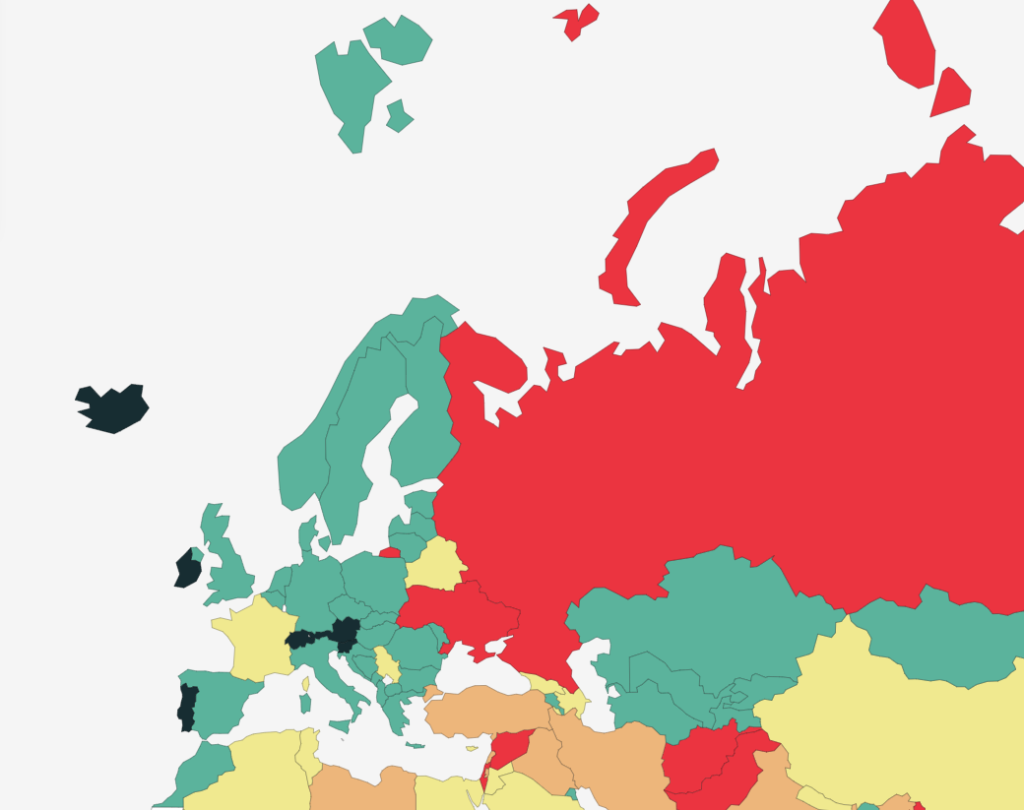
For decades, the “Nordic Model” has been synonymous with unparalleled stability, serving as a global benchmark for institutional trust, social cohesion, and predictable governance. However, the latest iteration of the Global Peace Index (GPI), produced by the Institute for Economics & Peace (IEP), reveals a more nuanced and fragmented reality.
While the Nordic region continues to outperform global averages, the rankings of its constituent nations are diverging. Driven by localized societal shifts, the structural realities of NATO integration, and the macroeconomic imperatives of the “Great Fragmentation,” the five Nordic nations are now moving at distinctly different velocities on the global stability leaderboard.
For senior executives, institutional investors, and policymakers, this divergence is not merely a statistical curiosity. It is a critical leading indicator of shifting risk profiles, evolving regulatory environments, and emerging capital allocation opportunities across Northern Europe. Understanding the mechanics behind these rankings is essential for navigating the region’s next economic chapter.
The Benchmark of Calm: Iceland’s Enduring Exceptionalism
Global Rank: #1 | Safety Tier: Exceptional
Iceland maintains its nearly two-decade streak at the summit of the GPI, a position underpinned by structural advantages that are largely unreplicable. With no standing military, virtually non-existent violent crime, and a highly integrated, geographically isolated population, Iceland achieves near-perfect scores across the GPI’s three pillars: Societal Safety, Ongoing Conflict, and Militarization.
Strategic Insight: For investors, Iceland represents a low-beta, highly stable environment. However, its economic scale and demographic constraints mean it functions as an outlier rather than a regional blueprint. Its primary value to the broader Nordic narrative is as a control group, demonstrating the baseline potential of the Nordic social contract when entirely decoupled from continental geopolitical friction.
The Stable Anchors: Denmark and Finland’s Geopolitical Tightrope
Global Ranks: #8 (Denmark), #9 (Finland) | Safety Tier: Very High (External source)
Denmark and Finland continue to exemplify the classic strengths of the Nordic Model, excelling in domestic harmony, political stability, and economic resilience. Citizens in both nations report high levels of personal safety, and institutional corruption remains negligible.
However, their trajectories are being shaped by distinct external pressures. Finland’s ranking reflects a delicate, necessary balancing act. Its formal integration into NATO has mandated a structural increase in defense spending, border security, and military readiness. While these measures are vital for national sovereignty, the GPI’s methodology inherently penalizes such militarization, creating a slight drag on Finland’s overall score.
Strategic Insight: Finland’s “geopolitical drag” on the index is, in reality, a signal of economic recalibration. The country is rapidly developing a robust defense-tech and secure supply chain ecosystem. For forward-looking investors, this presents a high-growth vertical, even as traditional metrics of “peace” temporarily adjust to the new security paradigm. Denmark, meanwhile, remains the region’s steady hand, successfully balancing deep EU integration with formidable domestic resilience.The Rankings: A Region Divided
| Global Rank | Country | Safety Tier | Key Drivers |
| 1 | Iceland | Exceptional | 18th consecutive year at 1; no standing military; virtually non-existent violent crime; immense social cohesion |
| 8 | Denmark | Very High | Excellent societal safety, high political stability, strong economic and social resilience |
| 9 | Finland | Very High | High domestic security and social trust; minor drag from NATO-related militarisation indicators |
| 32 | Norway | High | Strong internal safety, but weighed down by weapon exports and increased defence spending metrics |
| 35 | Sweden | Moderate-High | High institutional trust, but significantly impacted by domestic gang-related violence and rising violent crime indicators |
Source: Global Peace Index 2025, Institute for Economics & Peace (External Source)
The Arctic Paradox: Norway’s Defense-Led Recalibration
Global Rank: #32 | Safety Tier: High
Norway’s position outside the top 30 frequently surprises observers accustomed to its reputation for high living standards and domestic tranquility. This divergence is almost entirely a methodological artifact of the GPI, which heavily penalizes nations with high levels of militarization and arms manufacturing.
Norway is a sophisticated exporter of military technology and maritime defense systems. Furthermore, escalating regional tensions have necessitated increased military spending and heightened surveillance activities along the Arctic frontier. Consequently, Norway’s militarization score has risen, anchoring its global rank despite stellar internal safety marks.
Strategic Insight: Norway’s GPI ranking should not be misread as a decline in domestic stability. Rather, it reflects the nation’s strategic maturation into a primary security guarantor of the High North. For global capital, this underscores Norway’s expanding footprint in defense, cybersecurity, and Arctic logistics—sectors that are insulated from broader European economic headwinds by strong sovereign backing.
The Domestic Friction Point: Sweden’s Urban Security Challenge
Global Rank: #35 | Safety Tier: Moderate-High
Sweden occupies the lowest rank among the Nordic cohort, a position driven primarily by internal domestic challenges rather than external military threats. Over the past several years, Sweden has confronted a well-documented surge in organized gang violence and firearms incidents, particularly in the peripheries of its major urban centers. This has caused a measurable deterioration in its Societal Safety and Security indicators, specifically regarding the public perception of criminality.
Compounding this domestic friction is Sweden’s own defense realignment. Its abandonment of historical military non-alignment and subsequent defense investments have driven up its militarization score, layering geopolitical metrics atop domestic policing challenges.
Strategic Insight: Urban security is Sweden’s most pressing structural risk, with tangible implications for labor market dynamics, urban real estate valuations, and the country’s ability to attract and retain top-tier global talent. However, market friction breeds innovation. This challenge is actively catalyzing a booming domestic market for civic technology, predictive policing software, and advanced private security solutions, presenting targeted opportunities for specialized venture capital.
Conclusion: A Region in Strategic Transition
The Nordic countries demonstrate that “peace” in the 2020s is a highly multi-dimensional metric. Domestically, the region remains an unparalleled haven of institutional trust and social safety. However, the macro trends of the Great Fragmentation—characterized by rising regional defense spending, the normalization of NATO expansion, and specific domestic criminal friction—mean that a monolithic “Nordic stability” brand no longer exists.
For decision-makers, the takeaway is clear: risk premiums in Northern Europe are beginning to differentiate by country. The region is not losing its stability; it is actively adapting to a more complex world. The divergence in the GPI is not a bug, but a feature, of a region transitioning from post-Cold War complacency to 21st-century strategic resilience. Navigating this landscape requires moving beyond broad regional generalizations and embracing a granular, country-specific understanding of risk and opportunity.
Editorial Outlook
In our next quarterly deep-dive, Nordic Business Journal will explore: “The Rise of Nordic Defense-Tech: Capitalizing on the Region’s Security Recalibration.” We will analyze how increased sovereign defense spending in Finland, Sweden, and Norway is spawning a new ecosystem of dual-use technology startups, and what this means for venture capital allocation and cross-border M&A in the coming decade.
Stay Connected with Nordic Business Journal
About Nordic Business Journal
Nordic Business Journal is the premier platform for senior executives, investors, policymakers, and internationally minded business leaders seeking authoritative analysis of the Nordic and Baltic region. We provide independent, data-driven insight on markets, innovation, geopolitics, sustainability, and competitive strategy.
Connect With Us
For further insights, partnership inquiries, and editorial discussion, we invite readers to connect with Nordic Business Journal:
- Editorial: editor@nordicbusinessjournal.com
- Partnerships & Events: partnerships@nordicbusinessjournal.com
- Subscriptions & Access: subscribe@nordicbusinessjournal.com
- LinkedIn: linkedin.com/company/nordic-business-journal
- Twitter/X: @NordicBizJournal
Nordic Business Journal welcomes contributions from industry leaders, academic researchers, and policy practitioners. For submission guidelines and editorial standards, please visit our website.
Published June 2026. All data sourced from the Institute for Economics & Peace Global Peace Index 2026, the World Intellectual Property Organisation Global Innovation Index 2025, and official national statistics. The views expressed are those of the editorial team and do not necessarily reflect the positions of any affiliated institution.
Navigating the complexities of the Nordic and broader European markets requires timely, authoritative intelligence.
Empowering global leadership with Nordic clarity.