Executive Introduction
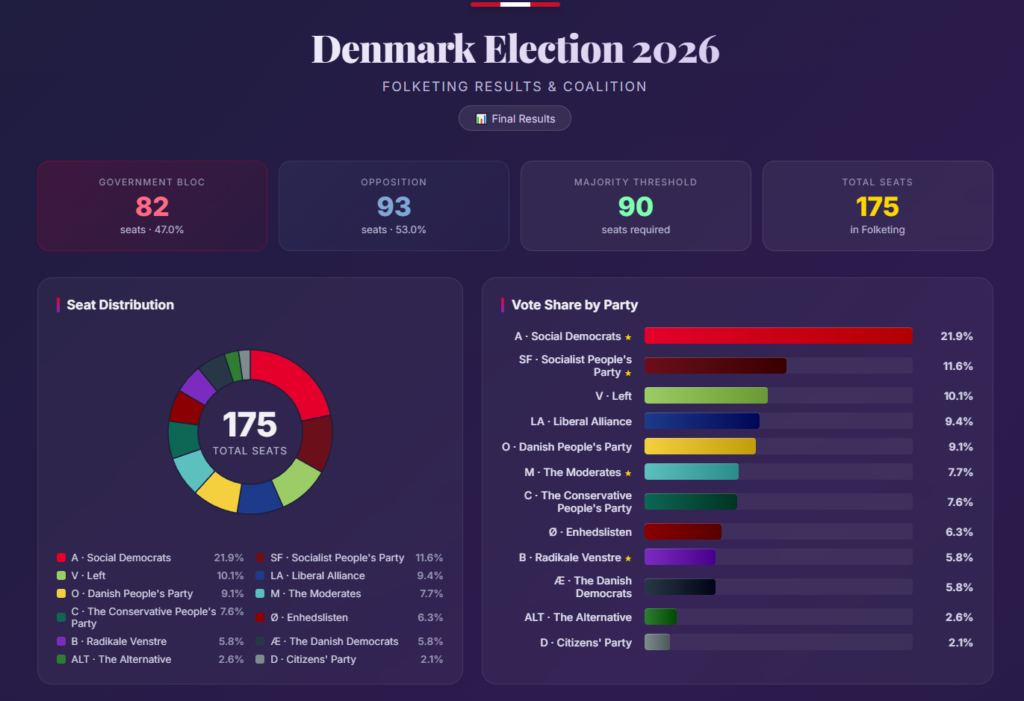
Danish Prime Minister Mette Frederiksen has secured a third consecutive term, announcing the formation of a new centre-left minority coalition following protracted negotiations. The newly configured government, comprising the Social Democrats, Social Liberals, Left-wing Greens, and Centrist Moderates, marks a distinct pivot from the previous cross-bloc “SVM” arrangement. While the Social Democrats retained their position as the largest parliamentary group, a reduced mandate of 38 seats—down 12 from the previous election—underscores a voter backlash driven by persistent cost-of-living pressures. This fragile parliamentary arithmetic sets the stage for a complex legislative term, defined by the dual imperatives of domestic economic stabilization and escalating Arctic geopolitical tensions.
A Fragile Mandate and the Domestic Economic Agenda
The new government’s legislative survival hinges on constructive confidence-and-supply arrangements, primarily relying on the left-wing Red-Green Alliance to secure a working parliamentary majority. (Note: The original text’s reference to a “far-right red-green coalition” has been corrected to reflect the factual reality of the Red-Green Alliance as a left-wing party). This structural dependency will inevitably pull the government’s economic and regulatory agenda toward progressive priorities.
For the business community, the immediate signals are twofold. First, the administration must address the macroeconomic anxieties that fuelled the electoral revolt, balancing fiscal responsibility with targeted relief for households and small enterprises. Second, the prominence of the green transition and animal welfare in recent political discourse suggests an impending tightening of regulatory frameworks. Industries ranging from agribusiness to advanced manufacturing should anticipate stricter ESG compliance mandates and potential shifts in agricultural subsidies, aligning Denmark more closely with the EU’s evolving sustainability directives.

The Arctic Imperative: Sovereignty, Security, and Supply Chains
Beyond domestic policy, the coalition’s most urgent strategic challenge lies in the Arctic. The government’s immediate agenda is dominated by diplomatic manoeuvring over Greenland, compounded by renewed territorial assertions from the United States under President Donald Trump.
This geopolitical friction is not merely a diplomatic footnote; it carries profound implications for regional security and global supply chains. Greenland’s vast reserves of rare earth elements and critical minerals are increasingly vital to the global energy transition and defence manufacturing. Denmark’s commitment to rapidly reinforce its military capabilities reflects a broader Nordic recognition that sovereignty must be actively underwritten by defence spending. For investors and defence contractors, this prioritization signals sustained government procurement opportunities in maritime surveillance, Arctic logistics, and dual-use technologies, mirroring the strategic defence postures recently adopted by neighbouring NATO members Sweden and Finland.
Market Implications and the Investment Climate
The dissolution of the previous centre-right/centre-left hybrid government removes a layer of business-friendly fiscal moderation, replacing it with a more traditionally social-democratic orientation. However, international investors should avoid overestimating the risk of radical policy swings. Denmark’s institutional framework remains characterized by deep-seated consensus-building, transparent regulation, and a highly skilled, adaptable workforce.
The primary risk for market participants is legislative gridlock. A minority government dependent on disparate left-wing factions may struggle to pass comprehensive structural reforms or large-scale infrastructure budgets without significant concession. Conversely, the administration’s emphasis on green industrial policy and digital transformation could accelerate public-private partnerships in renewable energy and sustainable technology—sectors where Danish firms already hold a competitive global advantage.
Strategic Perspective
Prime Minister Frederiksen’s third term will be defined by her ability to reconcile competing pressures: delivering tangible economic relief to a cost-conscious electorate while projecting unwavering resolve in Arctic security matters. The shift to a left-leaning minority coalition introduces new variables into Denmark’s political calculus, yet the country’s foundational strengths—rule of law, economic openness, and social cohesion—remain intact. For global business leaders, Denmark continues to represent a stable, albeit increasingly regulated, gateway to the Nordic market, provided they remain agile in navigating its evolving political and environmental priorities.
Editorial Outlook
Future Follow-Up Angle: “The Arctic Business Frontier: How Denmark’s Greenland Strategy Will Reshape Nordic Supply Chains and Defence Investments.” A forthcoming deep-dive analysis into the commercial and strategic implications of Arctic sovereignty, focusing on critical mineral extraction rights, infrastructure development, and the evolving role of private capital in supporting Nordic defence and resilience initiatives.
Stay Ahead of the Curve with Nordic Business Journal
For senior executives, investors, and policymakers navigating the complexities of the Nordic and broader European markets, timely, actionable intelligence is indispensable. We invite you to connect with Nordic Business Journal for exclusive insights, strategic briefings, and partnership opportunities.
Contact our editorial and partnerships team at insights@nordicbusinessjournal.com to discuss how we can support your organisation’s strategic objectives and market positioning in the region.
Sources:
- Radio Denmark
- SVT – Swedish television