Executive summary
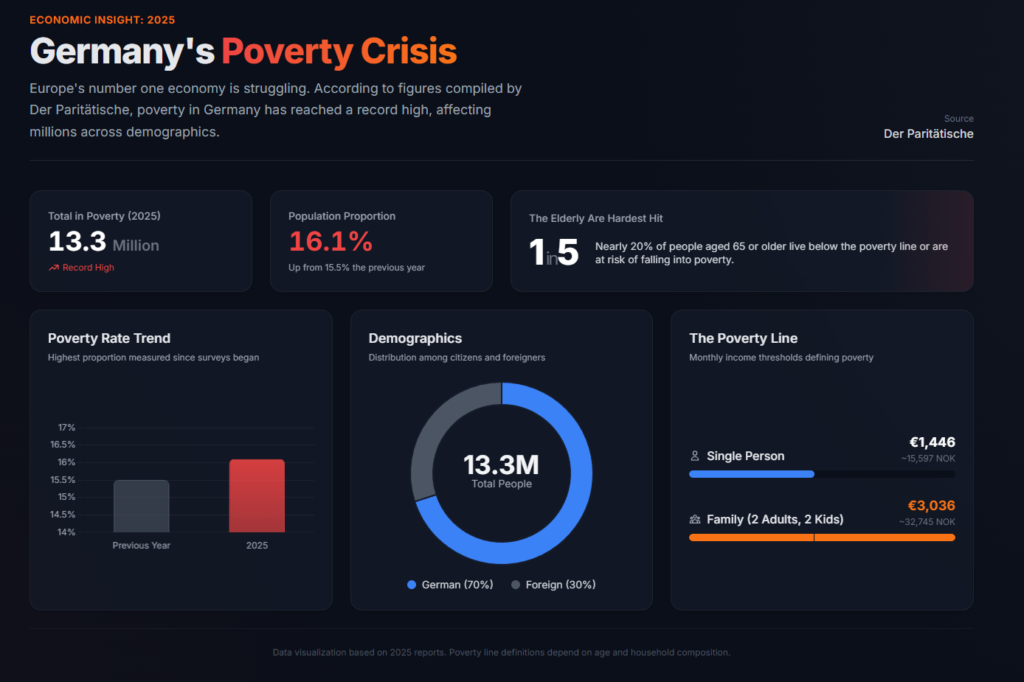
Germany’s recent rise in relative poverty — reported by the welfare network Der Paritätische as an at-risk-of-poverty rate of roughly 16.1% (by the EU standard of below 60% of national median income) — is more than a social policy headline. It is a signal that Europe’s largest economy is undergoing an extended structural adjustment: energy transition, deindustrialisation pressures, demographic strain, and shifts in labour composition are combining to erode household resilience. For senior executives, investors and policymakers, the implications are threefold: lower European demand for traded goods, new constraints on euro-area monetary policy, and changing patterns of intra‑European supply and investment that open strategic opportunities — especially in cleantech, housing, digital services and care economy solutions. This article synthesises the drivers, cross-border spillovers and strategic implications for business and policy, and sets out where to watch next.
The new face of poverty in Germany
Germany measures “poverty” as the share earning less than 60% of the national median — a relative metric embedded in EU statistics. The Der Paritätische figures — that more than 13 million people now fall into this category — underscore how living‑standard pressures have become widespread even in a high‑income economy. Crucially, this is not concentrated only among traditional vulnerable groups: the data reveal elevated risk among retirees, single-parent households, the unemployed and displaced industrial workers.
Why it matters now
Germany is Europe’s largest domestic market and its industrial hub. Weakness there has outsized effects on suppliers across the EU and beyond, on euro‑area macro policy, and on confidence in investment flows. The timing is critical: the post‑pandemic recovery intersected with Russia’s invasion of Ukraine, triggering an energy shock that accelerated business model change and forced rapid re‑allocation of capital. Policymakers and corporates are reacting — but the adjustment is both uneven and protracted.
Core drivers: a confluence of shocks and structural trends
1) Energy shock and lasting cost-of-living effects
The abrupt reduction in Russia‑sourced gas in 2022 inflicted large short‑term costs on industry and households. While headline inflation has fallen from its peaks, many price increases — particularly for housing, energy‑related services and food — are persistent, compressing real incomes and pushing a larger share of households below the median.
2) Industrial transition and labour market displacement
Germany’s export‑oriented, energy‑intensive manufacturing model has come under pressure from higher input costs, intensified global competition and the need to decarbonise. Production cuts and slower capital spending have displaced workers into services that tend to pay less, increasing income polarisation and reducing upward mobility in some regions.
3) Demographics, pensions and retirement vulnerability
An ageing population means more pensioners drawing income while a smaller workforce funds it. Historical employment gaps — particularly for women who took interrupted careers around child-rearing — translate into lower pension accrual, making elderly poverty a growing policy concern.
4) Household composition and care constraints
Single‑parent households and the unemployed are disproportionately affected. Limited affordable childcare and rigid labour arrangements contribute to low labour force attachment for some parents, reinforcing poverty cycles.
Cross-border effects: three channels for contagion and opportunity
1) Trade and demand
As German consumers retrench and manufacturers scale back, imports fall — a direct shock to exporters across Central and Eastern Europe and a drag on global supply chains. Nordic suppliers, particularly those exposed to German manufacturing, will face weaker demand in the near term but can benefit if they pivot to solutions supporting Germany’s transition (e.g., energy efficiency, electrification technologies).
2) Monetary policy and euro‑area growth dynamics
A weaker Germany complicates the European Central Bank’s task: balancing service‑sector inflation in southern Europe with the need to avoid deepening weakness in the bloc’s industrial core. Persistent German stagnation risks keeping the euro soft, adding volatility for internationally exposed firms and investors.
3) Re‑regionalisation and reshoring
In response to high costs and geopolitical risk, Germany is accelerating public investment in domestic and European supply chains, green technologies and critical infrastructure. That creates opportunities for intra‑EU partnerships and for Nordic companies with advanced cleantech, digitalisation and manufacturing expertise — but it also means competition for non‑European suppliers.
Government: social stabilisers and investment
German federal and state governments have moved to protect households and industries while accelerating green and digital investments. Expect continued emphasis on energy security, affordable housing initiatives, labour market activation (including childcare provision and upskilling) and targeted pension reforms. The fiscal balance will be politically sensitive; social spending increases must be paired with productivity and labour‑market reforms to be sustainable.
Business: adapt to demand shifts and partner on transformation
Reconfigure market exposure: Companies heavily dependent on German demand should stress‑test scenarios for prolonged low growth and broaden customer bases across the Nordics, Southern Europe and export markets.
Offer transition solutions: There is commercial growth in decarbonisation technologies, energy efficiency retrofits, modular manufacturing and digital services that increase productivity — areas where Nordic firms are competitive.
Invest in people and productivity: Firms must plan for reskilling to bridge workers displaced from traditional manufacturing into higher‑value services and green industries.
Investment view: risks and selective opportunity
Rising domestic weakness increases short‑term macro risk in Europe — weaker demand, currency volatility and political uncertainty. However, strategic investment opportunities arise where public funds and private capital converge: energy infrastructure, residential construction (affordable housing), care services, and technologies that lower operating costs or meet regulatory green standards. Investors should prioritise assets with resilient cash flows and exposure to the policy priorities of Germany’s federal and EU recovery/transition programmes.
Comparative Nordic perspective
Nordic economies, with deeper welfare safety nets, higher labour participation (especially maternal), and active labour-market policies, show lower rates of relative poverty among retirees and single parents. This offers a contrast and a set of policy lessons — especially around childcare, lifelong training and household support — that German policymakers are watching. For Nordic firms, Germany’s reorientation presents a sizeable market for exports and partnerships in low‑carbon solutions, smart housing, and digital healthcare.
Risks to watch
Political backlash: Rising economic insecurity can fuel populism and protectionist policies, complicating cross‑border cooperation.
Fiscal strain: Sustained social spending without growth could raise borrowing costs and crowd out investment.
Geopolitical shocks: Renewed energy or trade disruptions (e.g., new sanctions or supply‑chain blockages) would exacerbate vulnerabilities.
Structural unemployment: Slow reallocation of labour and skills mismatch could create long‑term scarring.
Conclusion: turn signals, not a policy failure
Germany’s rise in relative poverty is a sign of structural change rather than a one‑off crisis. For decision‑makers, the imperative is to convert short‑term stabilisation into long‑term inclusion: accelerate investments that raise productivity and lower household costs, reform labour and pension systems to reflect new work patterns, and harness private capital to scale low‑carbon solutions. For investors and corporate leaders, the strategy is twofold — mitigate exposure to near‑term demand weakness, and position for the structural opportunities created by Germany’s green and digital reindustrialisation.
Editorial Outlook
Future follow‑up proposal: “Partnering the Transformation — How Nordic Firms Can Lead Germany’s Industrial Greenprint”
A deep dive that profiles specific sectors (heat‑pump and electrification technologies, low‑carbon steel and materials, digital building platforms, and eldercare tech), maps likely government procurement and funding streams, and provides case studies of successful Nordic‑German partnerships. The piece would also model investment returns under different policy and macro scenarios to guide corporate and institutional capital allocation.
Reader engagement
Nordic Business Journal welcomes conversation and collaboration. If you are a corporate strategist, investor, policymaker or entrepreneur seeking bespoke analysis, partnership introductions, or to propose data‑driven case studies for future coverage, please contact our editorial team. Connect with us to share insights, suggest sources, or discuss commissioning targeted briefings for your organisation.
By Daniel Obose in Copenhagen, Denmark Daniel.obose@nordicbusinessjournal.com
References
Der Paritätische Gesamtverband (2024) Armut in Deutschland 2024. Berlin: Der Paritätische Gesamtverband. Available at: https://www.der-paritaetische.de/aktuelles/presse/pressemitteilungen/ (Accessed: 2 June 2026).
Eurostat (2024) People at risk of poverty or social exclusion. Luxembourg: Eurostat. Available at: https://ec.europa.eu/eurostat/statistics-explained/index.php?title=People_at_risk_of_poverty_or_social_exclusion (Accessed: 2 June 2026).
International Energy Agency (IEA) (2022) A 10‑Point Plan to Reduce the European Union’s Reliance on Russian Natural Gas. Paris: IEA. Available at: https://www.iea.org/reports/a-10-point-plan-to-reduce-the-eu-s-reliance-on-russian-natural-gas (Accessed: 2 June 2026).
OECD (2023) Pensions at a Glance 2023: OECD and G20 Indicators. Paris: OECD Publishing. Available at: https://www.oecd.org/pensions/pensions-at-a-glance.htm (Accessed: 2 June 2026).